



How to Find the Right Size Leather Watch Band
Getting the right size leather watch band comes down to one measurement for traditional watches: lug width, the gap in millimeters between the two metal posts on the watch case where the band attaches. Apple Watch bands work differently, sized by case-size group rather than a millimeter measurement.
Finding your lug width (traditional watches)
- Check your watch's original specifications or manual, which usually list lug width directly
- If you don't have the specs, measure the gap between the two lugs (the small metal posts that hold the spring bar) with a ruler, in millimeters
- Common sizes are 18mm, 20mm, and 22mm; the band width must match this measurement exactly, not the wrist size or watch case diameter
Common lug widths and what they typically fit
| Lug width | Typical fit |
|---|---|
| 18mm | Smaller men's watch cases and most women's watches |
| 20mm | The most common size for men's dress and sport watches |
| 22mm | Larger sport watches and tool watches with proportionately larger cases |
Apple Watch sizing works differently
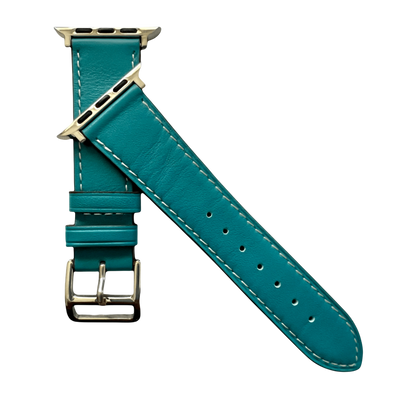
Apple Watch leather bands don't use lug width or spring bars at all. Instead, Apple's proprietary attachment system uses two pins that slide into channels on the watch case, released by a button rather than tools. Sizing is based on case-size group: the 38/40/41mm case group shares one band width, and the 42/44/45/49mm group, including Apple Watch Ultra, shares a wider one. You only need to know which group your specific Apple Watch case falls into, not a separate millimeter measurement. Our Apple Watch leather bands guide covers this attachment system and case-size groups in more detail.
Standard spring bars vs. quick-release
On traditional watches, standard spring bars require a small tool to compress and remove, while quick-release spring bars have a lever that lets you swap bands in seconds with no tools. Both use the same lug-width sizing; the difference is purely in how easily the band comes on and off, not in fit.
Common mistakes when measuring lug width
- Measuring the watch case diameter instead of the lug gap. These are two entirely different measurements; case diameter (often 38-46mm) is much larger than lug width (typically 16-24mm) and has no bearing on band sizing.
- Rounding an odd measurement up or down without checking. Most watches use even-numbered lug widths, but some use odd sizes like 19mm or 21mm; measure carefully rather than assuming the nearest even number.
- Assuming wrist size determines the band width needed. Wrist size affects band length and how many holes you'll use, not the width required to physically fit the lugs.
What to do if you can't find the specs and can't measure precisely
If measuring the lug gap directly isn't practical, look up your watch's exact model number online, since manufacturer specifications for lug width are widely documented for most mainstream watch models. A local jeweler or watch repair shop can also measure it accurately in a few seconds if you bring the watch in.
Once the width fits, sizing the length correctly
Lug width determines whether a band physically attaches to your watch at all; length and hole spacing determine how it actually fits your wrist once attached. Most leather bands come with several holes spanning a range of wrist sizes, and a band that's the correct width but runs too long or too short for your wrist can often still work by choosing a different hole, though a band sized close to your actual wrist circumference from the start sits and wears more naturally. If your new band still feels stiff or unfamiliar the first week, that's a separate, temporary issue covered in how to break in a stiff new leather watch band.
Why some watches taper their lug width toward the buckle
Many watch bands are built with a tapered profile, wider at the lugs where they attach to the case and progressively narrower toward the buckle end. This is a style and comfort choice rather than a sizing concern: the lug-width measurement always refers to the wider end where the band meets the case, and the taper is usually specified separately (for example, 22mm tapering to 18mm) if you're buying a band that needs to match a specific buckle width as well. Most watches don't require matching the taper exactly since the buckle end sits loosely regardless, but it's worth checking the product listing if your watch has an unusually proportioned case.
What to do if a band feels right at the lugs but shifts or wobbles
Occasionally a band matches the stated lug width but still feels slightly loose or shifts side to side at the attachment point. This is more often a spring bar tension issue than a true width mismatch; a spring bar that's slightly worn or not seated fully in the lug holes can create play even with a correctly sized band. Reseating the spring bar or replacing it with a fresh one, a five-minute job with the right tool, usually resolves this without needing a different band at all.
Frequently asked questions
What happens if I order the wrong lug width?
A band too narrow will sit loosely between the lugs and may shift or damage the case over time; a band too wide simply won't fit between the lugs at all. Lug width needs to match exactly, unlike wrist size, which has some flexibility through buckle holes.
Does wrist size affect which watch band I should buy?
Wrist size affects overall band length, which is usually adjustable through the buckle across a wide range and rarely requires choosing a different product. Lug width, not wrist size, is what determines whether a band physically fits your watch case.
Can I use a wider band than my watch's lug width if I trim it?
No. Lug width isn't something you can adjust by trimming; the metal fittings and spring bar attachment points are built for a specific width. You need a band manufactured at your exact lug width.
Do all watch brands use the same lug width standards?
Most conventional watch brands (Seiko, Tissot, Hamilton, and similar) use the same standard spring-bar system and common width increments like 18, 20, and 22mm, but always check your specific watch's lug width rather than assuming based on brand or style.
Is it possible for a watch to have an odd lug width like 19mm?
Yes, some watch models use odd-numbered lug widths, which is exactly why it's worth measuring or checking specifications directly rather than assuming a common even size.
How do I know which Apple Watch case-size group I have?
Check the back of the watch case, which typically lists the case size in millimeters, or check the original packaging or your Apple ID purchase history if you bought it through Apple directly.
If my wrist is unusually small or large, does that change what band width I need?
No, only the length and hole positioning need to accommodate an unusual wrist size. Band width is determined entirely by lug width, which is set by the watch case, not your wrist.
Why does my correctly sized band still wobble slightly at the lugs?
This is usually a spring bar issue rather than a band sizing problem. A worn or improperly seated spring bar can create play even with a correctly measured band, and reseating or replacing it typically fixes the wobble.
Updated: September 27, 2026
Related reading
For a broader breakdown of band width conventions, see our watch band width and sizing guide. Browse our leather watch bands.


Leave a comment