How to Clean and Care for a Leather Keychain
A leather keychain gets handled more than almost any other everyday item, pulled out dozens of times a day and dragged across pockets, counters, and bags. It still needs surprisingly little maintenance: an occasional wipe, conditioning a few times a year, and some attention to where the leather meets the metal hardware.
Basic cleaning
- Wipe the leather with a slightly damp cloth to remove pocket lint, hand oils, and everyday grime
- For a keychain that's visibly dirty, use a small amount of leather cleaner formulated for vegetable-tanned leather rather than household soap, which can strip natural oils and dry the leather out
- Let it air dry fully before conditioning; conditioning damp leather traps moisture underneath
Conditioning
Condition a leather keychain two to three times a year, less often than a wallet or belt since a keychain is a smaller piece with less surface area exposed to wear. Work a small amount of conditioner into the leather with a soft cloth, focusing on any areas that feel dry or stiff, and let it absorb for a few hours before use. Our guide to how to clean a leather wallet covers the same basic conditioning principles at a scale that applies to any small leather good, keychains included.
The hardware attachment point needs specific attention
| Area | What to watch for |
|---|---|
| Where leather meets metal hardware | Hand oils accumulate here fastest since it's the point of most contact and stress; wipe it specifically during regular cleaning |
| Split ring or clasp | Check periodically that it still opens and closes with normal spring tension; solid brass or stainless steel hardware resists the corrosion that causes sticking |
| Stitching at the attachment | A saddle-stitched attachment holds even if a thread frays at one point; inspect occasionally for any loosening |
What shortens a keychain's life
- Leaving it wet for extended periods, which can dry out the leather unevenly once it does dry
- Storing it in direct sunlight or a hot car for long stretches, which accelerates drying and fading
- Using household cleaners or solvents not made for leather, which can strip finish or discolor the surface
A simple monthly care routine
| Step | What to do |
|---|---|
| 1 | Wipe the full length of the leather with a slightly damp cloth, paying extra attention near the hardware |
| 2 | Check the split ring or clasp for smooth opening and closing |
| 3 | Look at the stitching near the attachment point for any early signs of loosening |
| 4 | Let it fully air dry before returning it to your pocket or bag |
This takes well under a minute and, combined with conditioning two to three times a year, covers essentially everything a leather keychain needs for a decade of daily carry.
Why keychain leather ages differently from a wallet
A keychain spends more time in direct, repeated contact with skin than most other leather goods, since it's held and released constantly rather than sitting closed in a pocket. That contact accelerates the natural darkening and softening that comes with use, so a keychain often shows visible patina sooner than a wallet made from the same leather. Our guide to how leather develops patina over time covers what to expect from that process.
Caring for a handmade leather keychain from Hedonist Chicago
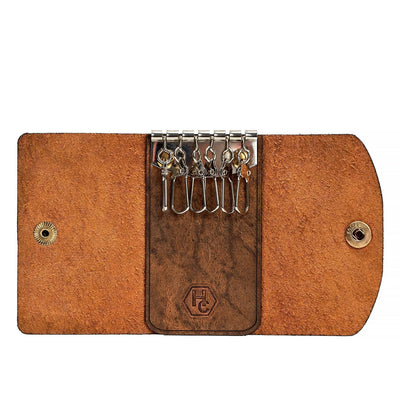
Our handmade leather keychains are made in Chicago from full-grain vegetable-tanned leather, available in colors including a deep red leather keychain and a rich green leather keychain alongside natural and dark tones. A handmade keychain like this benefits from the same care routine described above: an occasional wipe, conditioning two to three times a year, and attention to the hardware where it meets the leather. Because each piece is cut and stitched by hand rather than mass-produced, the leather on a Chicago keychain tends to be thicker and better suited to holding up to that conditioning schedule than a thinner, machine-stamped equivalent.
Frequently asked questions
How often should I clean a leather keychain?
A quick wipe whenever it looks visibly dirty is usually enough for everyday upkeep. Beyond that, a more thorough conditioning two to three times a year keeps the leather supple and prevents the cracking that comes from letting it dry out completely between treatments.
Can I use the same conditioner I use on my wallet or belt?
Yes, as long as it's formulated for vegetable-tanned leather rather than a generic all-purpose product. The same conditioner works across small and large leather goods; a keychain just needs it less frequently than a wallet or belt, given its smaller surface area and lighter daily wear.
Why does the area near the metal ring get dirty faster than the rest?
That's the point of most contact and stress on the entire piece, since it's where your fingers grip and where the weight of your keys pulls constantly throughout the day. Hand oils and grime accumulate there faster than anywhere else on the keychain, so it deserves extra attention during a regular wipe-down.
How long should a well-made leather keychain last?
A full-grain, vegetable-tanned leather keychain with solid brass or stainless steel hardware should last 5 to 10 years of daily use with basic care. One with plated hardware or corrected-grain leather typically fails much sooner, as the hardware corrodes or the leather stretches and cracks at the attachment point well before that.
Is it normal for a leather keychain to darken faster than my wallet?
Yes. A keychain is handled and released constantly throughout the day, so it accumulates contact-point patina faster than a wallet, which spends most of its time closed in a pocket rather than in direct hand contact. That faster darkening is a sign of regular use, not a construction flaw.
Does the number of keys I carry affect how fast a keychain wears out?
Somewhat. A heavier keyring puts more constant pull on the attachment point and hardware, which can accelerate wear there compared to a lighter, smaller set of keys. Anyone carrying several keys and a fob should check the split ring and stitching a bit more often for early signs of strain.
Can rust or corrosion on the hardware be cleaned off?
Light tarnish on solid brass can often be gently polished away with a brass-safe cleaner. Actual rust or corrosion on lower-grade plated hardware usually can't be fully reversed, since it typically means the plating has already worn through to a less corrosion-resistant metal underneath.
Should I check the split ring more often on a heavily loaded keychain?
Yes. A ring carrying several keys and accessories experiences more constant stress than a lightly loaded one, so it's worth inspecting more frequently for signs of an opening that no longer closes fully.
How do I clean and care for a leather keychain overall?
Keep it simple: wipe the leather with a slightly damp cloth when it looks dirty, condition it two to three times a year with a product made for vegetable-tanned leather, and check the hardware and stitching at the attachment point occasionally. That's the entire routine for a handmade leather keychain, and it's less upkeep than most people expect for something handled this often.
How do I clean a leather keychain that's heavily soiled or stained?
For everyday grime, a damp cloth is enough. For a heavier stain, use a small amount of leather cleaner made for vegetable-tanned leather, work it in gently with a soft cloth, and let the leather air dry fully before conditioning. Avoid soap, solvents, or household cleaners, since they strip natural oils and can leave a permanent dry patch or discoloration.
Updated: September 28, 2026
Related reading
For more on the construction that holds up to this kind of daily handling, see our handmade leather key chains guide. Browse our handmade leather keychains.
Leave a comment