How Leather Develops Patina Over Time: What to Expect and Why It Matters
Leather patina is the visible record of how a piece has been used. The darkening at card slot edges, the burnished quality at a belt's buckle fold, the worn-smooth underside of a watch band at the wrist contact point. These are not signs of wear in the negative sense. They are signs that the leather is performing as designed under daily conditions that no synthetic material replicates. This guide covers what patina is, why it develops only in certain leather types, what the development looks like across different colors and formats, and why a leather accessory at two years of daily carry can look more considered than it did when new.
What Patina Actually Is
Patina in leather is a surface change caused by sustained contact with human skin oils, environmental moisture, light, and mechanical friction. In full-grain vegetable-tanned leather, these inputs cause the natural tannins in the leather to oxidize and the surface fibers to compact and smooth under repeated contact. The result is a color deepening and surface character that develops in the specific patterns of how each piece is used.
This process is distinct from simple fading or wear. Fading is a loss of color caused by UV exposure or chemical processes that strip pigment from the surface. Wear is a breakdown of the leather's fiber structure caused by stress exceeding the material's capacity. Patina is neither. It is a surface enrichment caused by contact and handling that makes the leather look more complex and individual over time, not simply older.
Not all leather develops patina. Chrome-tanned leather, which accounts for the majority of leather goods produced globally, does not develop patina in the same way. The chrome tanning process stabilizes the leather against environmental inputs that would cause it to develop color and surface character. Chrome-tanned leather stays relatively consistent in appearance until it begins to degrade. Vegetable-tanned leather is specifically responsive to the environmental inputs of daily carry because the plant-derived tannins remain active in the leather's structure, allowing the material to respond to handling instead of simply resisting it.
Full-Grain vs Corrected Leather and Why It Matters
Patina development requires the natural outer surface of the hide to be intact. Full-grain leather retains this surface, where fiber density is highest and the tannin concentration from vegetable tanning is deepest. When this surface is handled daily, the fibers compact and the tannins deepen in color at the contact points.
Corrected-grain and top-grain leather have had this surface layer sanded away to remove natural imperfections and create a more uniform appearance. The result is a smoother, more consistent surface when new, but one that lacks the fiber density and tannin concentration that allow patina to develop. These leather types show surface changes over time too, but the changes are degradation, not enrichment. The sanded surface develops scratches, cracks at flex points, and surface coating breakdown that looks worse over time, not better.
This is the material basis for a claim that sounds like marketing but is structurally accurate: a full-grain vegetable-tanned leather wallet, belt, or watch band can genuinely look better at two years of daily carry than it did on day one. The same claim cannot be made for corrected leather, because the surface changes that corrected leather undergoes are not enrichment.
How Patina Develops in Wallets
A leather wallet receives concentrated daily handling in a small surface area. The card slots flex hundreds of times per week as cards are inserted and removed. The exterior contacts bag lining, pocket fabric, and table surfaces continuously. The closure point, whether snap, zip, or fold, takes repeated mechanical stress at the same location. Each of these contact points develops patina at a different rate and in a different pattern.
Card slot edges are typically the first area to show visible development. The repeated contact and flexing at the slot edge compacts the fibers and deepens the color, creating a contrast between the burnished slot edge and the protected leather panel behind it. In cognac and tan leather, this contrast becomes visible within the first few months of daily carry. In darker leather, the contrast is subtler but still present as a sheen difference between the contacted and protected areas.
The exterior of the wallet develops overall deepening and a surface polish from contact with other materials. Areas that contact pockets or bag lining daily develop a friction-polished quality that catches light differently from protected areas. After a year of daily carry, the exterior of a full-grain wallet has a surface variation that no factory finish can replicate because it is specific to exactly how and where that wallet has been carried.
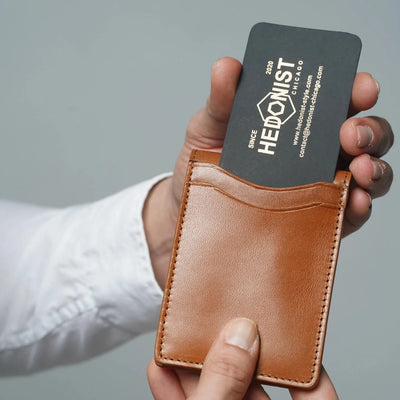
Statement colors develop particularly visible patina. Red leather develops burgundy undertones at high-contact areas while protected areas maintain the original red, creating a color depth that makes the wallet look more complex over time. Our red wallets guide covers how different shades of red develop over time. Cognac develops warm amber tones that concentrate at contact points, creating the richest visible patina of any neutral color. Our wallet color guide covers patina development across every color in the collection.
How Patina Develops in Belts
A leather belt develops patina in a more concentrated pattern than a wallet because the stress points are fewer and more defined. The buckle fold, where the belt bends around the buckle frame, takes the most consistent mechanical stress. The most-used hole position, where the prong contacts the leather with every wearing, develops a visible darkening and compaction at that specific point. The exterior surface develops overall deepening from contact with clothing and the friction of passing through belt loops.
At one year of daily wear, a full-grain leather belt has a buckle fold with a burnished quality that is distinctly darker and smoother than the protected sections. The most-used hole has a prong mark that darkens the leather around it in a pattern specific to how the belt is worn. These details make the belt look individual in a way that a new belt of identical specification cannot replicate. The patina is not damage. It is the physical record of daily use in a material designed to accumulate and express that record.
Brown and cognac leather belts develop the most dramatic visible patina because the warm tones deepen and create contrast between handled and protected areas. Black leather belts develop a subtle gloss and burnishing at contact areas that is less immediately visible but distinguishes a worn-in quality leather belt from a new one in good light. For belt selection guidance including color and leather grade, our leather belt style guide and our leather belts guide cover the full decision.
How Patina Develops in Watch Bands
A leather watch band develops patina through the most sustained and consistent contact of any leather accessory: continuous skin contact across a full day of wear. The wrist contact surface, the underside of the band, develops a worn-smooth quality from constant contact with the wrist that is unlike the patina development in any other leather good. The most-used hole position at the buckle darkens from pin contact. The exterior develops overall deepening from sleeve and cuff contact throughout the day.
Watch band patina is the most personal of any leather accessory because it is literally shaped by the wrist it has been worn on. The exact curvature of the band, the specific hole position, the pattern of wrist movement, and the environmental conditions of daily carry all leave their mark in the leather's surface. A full-grain vegetable-tanned watch band at six months of daily wear has developed a character that makes it recognizably its owner's, in a way that no new band of the same specification shares. For watch band guidance including color and construction, our Apple Watch leather bands guide and our traditional leather watch bands guide cover the full range.
Patina Across a Coordinated Everyday Carry
When a leather wallet, belt, and watch band share the same material, full-grain vegetable-tanned leather, and the same tone family, they develop patina in parallel. The wallet's card slot edge patina, the belt's buckle fold patina, and the watch band's wrist contact patina all develop through the same material process in the same color register. After a year of carrying all three daily, the pieces develop a visual coherence that a recently purchased set in the same colors cannot replicate.
This parallel patina development is the specific aesthetic payoff of choosing quality leather for every daily carry piece, not only for the most visible one. A quality wallet carried alongside a synthetic belt and a silicone watch band develops its own individual character in isolation. The same wallet alongside a belt and watch band in the same full-grain leather develops that character in a material context, creating coordination that deepens over time, not remaining static.
For men's coordination guidance, read our guide to styling leather accessories for men. For women's coordination, read our guide to styling leather accessories for women. For which leather accessories suit which dress code specifically, read our leather accessories dress code guide. For the broader style context including wallet, belt, and color coordination, read our leather wallets as a style statement guide. For the full leather accessories context, read our leather accessories guide.
How to Encourage Patina Development
Patina develops through use, not through any product or treatment. The single most effective thing you can do to encourage patina development in full-grain vegetable-tanned leather is to use the piece consistently and daily. Pieces that are used occasionally and stored most of the time develop slowly and unevenly. Pieces carried daily develop quickly and consistently across the entire surface.
Conditioning supports patina development by keeping the leather supple enough to respond to handling without cracking at flex points. A leather that is under-conditioned and dry develops stress cracks at flex points instead of burnishing. Conditioning every three to four months with a conditioner formulated for vegetable-tanned leather maintains the suppleness that allows the surface to compact and deepen through handling instead of cracking and splitting. For conditioning guidance and product recommendations, our leather treatments and conditioners guide covers the full care approach.
Direct sunlight accelerates color change in leather but in a different way from handling patina. UV exposure bleaches leather instead of deepening it, which can create uneven fading unlike the even deepening that handling produces. Storing leather goods away from direct sunlight when not in use preserves the even development that daily handling creates.
What Patina Looks Like at Different Stages
Understanding what to expect at each stage of patina development removes the surprise of how a leather piece looks as it develops, and helps distinguish normal patina from damage that requires attention.
In the first month of daily carry, changes are subtle. The leather begins to soften slightly at flex points. Light surface variation may appear at the most-handled areas. In very light leathers like tan and natural vegetable-tanned, slight darkening at contact areas may already be visible. Most colors show little visible change in the first month.
At three to six months, patina becomes clearly visible in warm-toned and lighter leathers. Card slot edges in cognac and tan wallets have developed visible darkening and burnishing. Watch band wrist contact areas have a worn-smooth quality. Belt buckle folds show the beginning of the burnished contrast that becomes more defined over the following months. Darker leathers in black and dark brown show subtle surface variation that becomes more apparent in good light.
At one year of daily carry, patina is fully established. The contrast between handled and protected areas is clear across all leather tones. Statement colors have developed their most distinctive character. Red leather carries burgundy depth at contact areas, cognac shows amber concentration at the highest-contact points. The piece has become individual in the sense that no two pieces carried through the same period develop identically, because no two people carry them in exactly the same way.
At two years and beyond, the patina deepens and stabilizes. New development slows as the leather reaches a surface character that reflects the specific conditions of its daily carry. A piece carried this long has a quality of presence and individuality that mass-produced leather accessories at any price point cannot achieve, because that presence is earned through sustained daily use in a material designed to accumulate and express it. For the complete leather care approach that supports this development over time, see our leather treatments and conditioners guide and our leather water resistance guide.
Leave a comment