Leather Luggage Tags: Materials and Terms Explained
Quick answer: Leather luggage tag listings use a few terms that describe real construction differences: full-grain (the hide's dense outer layer, which holds up to rough handling), hand-burnished edges (sealed rather than painted, so they do not chip), a buckle strap (a secure closure) and saddle stitching (a seam that does not unravel if one stitch breaks). Our handmade tags are $18.
Key terms explained
Term
What it means
Why it matters on a tag
Full-grain leather
Keeps the hide's dense outer layer
Resists cracking and tearing better than corrected-grain or bonded leather
Vegetable-tanned
Tanned with plant tannins
Develops a patina with travel
Hand-burnished edges
Edges smoothed and sealed
Painted edges can chip and peel quickly
Saddle stitch
Hand stitch with two needles through the same holes
Plastic can crack in cold cargo holds and fade in sun. Full-grain leather develops a patina and handles repeated handling. Plastic is a reasonable choice for infrequent travel.
Full-grain isn't strictly necessary for occasional light travel, but it holds up meaningfully better under the repeated rough handling checked luggage experiences on a regular basis. If you check bags several times a year, the extra durability at the strap attachment point and the fold is worth paying for over a lower-grade or bonded leather tag.
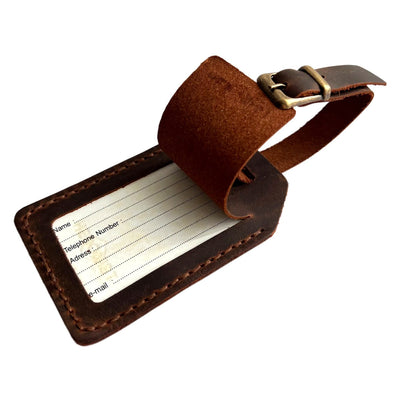
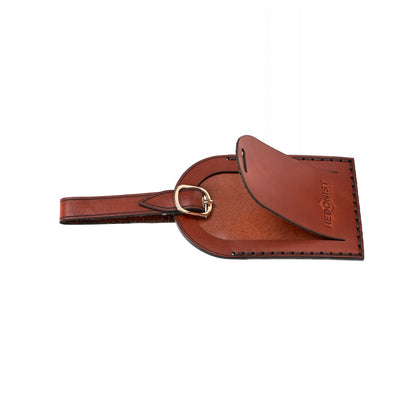
A buckle strap threads through the bag handle and fastens securely, resisting the kind of snagging or accidental opening that a simple loop or clip can be more prone to during handling. A wider buckle strap also spreads pulling force across more stitching, which matters when a bag gets thrown or dragged across a conveyor system.
An ID window protects your contact information from smudging, rain, and fading, keeping it legible throughout a trip. Writing directly on leather can smear or become hard to read after exposure to moisture, and ink can fade with sun exposure over repeated trips, so a window is worth having even on a tag you don't check often.
A full-grain, hand-stitched luggage tag with a secure buckle closure typically holds up for years of regular travel, developing patina along the way rather than showing wear. A synthetic or low-grade tag, by comparison, often needs replacing within a trip or two once the strap or stitching starts to fail.
Plated hardware such as nickel or brass resists the corrosion that comes from rain, humidity, and temperature swings in cargo holds. Unplated metal is more likely to rust and can streak onto the leather over time, leaving marks that don't clean off. Checking the hardware finish is a quick way to gauge overall build quality before buying.
For durability and appearance over time, generally yes. Plastic tags tend to crack in cold cargo holds and fade in direct sun, while full-grain leather develops a patina and holds up to repeated handling better across years of use. Plastic can be a reasonable low-cost option for infrequent travelers who check a bag once or twice a year.
Basic care, an occasional wipe-down and conditioning a couple of times a year, keeps a full-grain leather tag supple and prevents the drying that can eventually lead to cracking. This is the same routine that applies to any other leather accessory, and it takes only a few minutes between trips.
Yes, to a meaningful degree. A rounded profile without sharp corners resists snagging and tearing on conveyor machinery and cart edges better than a tag with pointed edges, which is why most durable designs favor rounded or oval shapes. Oversized tags also catch on equipment more easily than ones sized close to standard dimensions.
Full-grain keeps the hide's outer surface exactly as it grew, unsanded, which is why it resists cracking and tearing under the rough handling checked bags get. Top-grain is sanded smooth and often corrected, trading some of that structural strength for a more uniform, lower-cost surface. For a small, hard-working item like a luggage tag, full-grain generally holds up longer.
It's a hand-stitching method using two needles and waxed thread that interlock through the same holes, rather than a single machine thread run through. If one point frays, the stitching doesn't unravel the way a single-thread machine seam can. On a small piece like a luggage tag, where stitch length is limited, that extra durability at the attachment point matters.
Not fully, but it holds up reasonably well. Chrome-tanned leather resists water spotting better than vegetable-tanned, and a tag with a protective ID window keeps the written contact information from smudging in rain. None of this makes the tag fully waterproof, so it's still worth wiping it dry after a wet trip rather than leaving moisture sitting on the leather.
Most leather luggage tags use a strap that threads through the handle and fastens with a buckle or secure snap, rather than a simple loop and metal ring. A wider strap with a buckle spreads the pulling force across more leather and stitching, while a narrow loop concentrates stress on one small stitched point, which is more likely to fail during handling.






Leave a comment