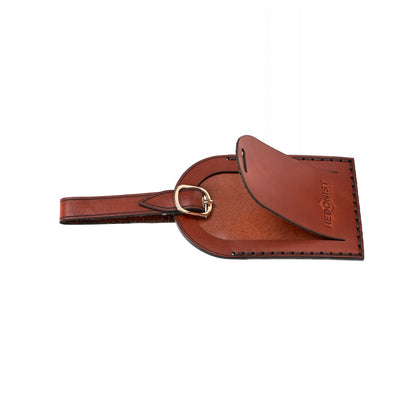
Quick answer: Write your name and a phone number or email on a luggage tag, and leave off your full home address. A destination hotel is optional and better kept on a removable card than permanently on the tag. A leather tag with a buckle strap and a covered ID area keeps your details private. Our handmade leather luggage tags are $18 with free personalization.
An address on a visible tag tells anyone who sees it where your home is, and where you are not. A phone number or email is enough for an airline or finder to reach you.
Personalizing a leather tag
Personalization is free: up to 40 characters including spaces, so a name and a short contact fits. Personalized items are final sale. Browse handmade luggage tags and read the luggage tag guide.
Yes, a name alone doesn't carry much privacy risk and helps confirm ownership if your bag is found or flagged for extra screening. The bigger consideration is what additional information you pair it with, since a name next to a home address tells a stranger far more than a name next to a phone number does.
It's optional. It can help route a misdirected bag directly to where you're staying, but consider writing it on a removable insert or business card rather than permanently on the tag, since your destination changes with every trip. A permanent hotel name on a tag you reuse for years quickly becomes outdated and confusing.
Consider replacing it with one that does, since an exposed label is more likely to smudge, fade in rain, or become harder to read after repeated handling. In the meantime, fold a piece of paper with your contact information so the writing faces inward rather than sitting fully exposed to anyone who picks up the bag.
It's a reasonable addition, but not a true substitute. A phone number is generally more useful for immediate contact, since most people check texts or calls faster than email while traveling and may not have reliable internet access. Use email as a backup contact method rather than your primary one.
For trips within your own country it isn't necessary, since local staff already recognize the number format. It's worth adding for any international leg of a trip, though, since airport or airline staff in another country may not otherwise recognize a number without its country code and could struggle to reach you.
Yes, it's a reasonable extra precaution. An exterior tag can be torn off entirely during handling, especially over multiple connections and transfers, leaving a bag with no visible contact information at all. A card with the same details tucked into an interior pocket gives baggage staff a backup if that happens.
Yes. A tag made from lower-grade leather or without a protective ID window is more likely to have its writing smudge, fade, or become illegible during a multi-leg trip through different climates and handling conditions. That defeats the purpose of the tag regardless of what information you originally chose to include on it.
Yes. A tracker helps you find your bag's location on a map, but it doesn't give a baggage handler, hotel employee, or another traveler any way to identify the bag or contact you directly if they find it. A physical tag and a digital tracker solve two different problems, so it's worth using both.
At minimum, your full name and a mobile phone number, ideally with a country code if you're traveling abroad. An email address is a useful backup contact. Skip your home address since a tag is visible to anyone who handles or walks past the bag, and a phone number does the same job without broadcasting where you live.
Leave your home address off the tag. It's the one piece of information with real privacy risk and little upside over a phone number, since a bag passes through many hands during a trip. Old destination stickers and barcodes from past trips should also come off before you check a bag again, since they can confuse scanning systems.
The same core details work for flights: your name, a mobile number with country code for international travel, and optionally an email. Airline staff say a working phone number is the single most useful piece of information, since they can contact you as soon as a bag is scanned, often before it reaches the carousel.





Leave a comment