Card Holder vs. Belt: Why Hand-Stitching Matters More on Small Leather Goods
A leather belt and a leather card holder can come from the same hide, the same tannery, even the same workshop. The standard a craftsman has to hit on each one isn't the same, though. Scale changes what "good stitching" actually means, and it changes how much room there is to hide a mistake.
Here's how the two compare at a glance:
| Belts & larger goods | Card holders & small goods | |
|---|---|---|
| Stitch line length | Long, forgiving of minor drift | Short, every stitch sits close to an edge or corner |
| Edge finishing | One continuous burnished run | Several tight corners per piece, each one a chance to round unevenly |
| Hardware alignment | One buckle, one clear axis | Multiple pockets/slots have to line up within a few millimeters of each other |
| Leather consistency | Grain variation blends into a long strap | A single scar or loose grain patch can dominate a small panel |
| Hand-stitching's job | Reinforces load points | Often the only thing holding thin panels together |
The Math of Visible Error
A belt is roughly 1.25 to 1.5 inches wide and can run 40+ inches long. A stitching line that drifts half a millimeter over that length is close to invisible. A card holder folds down to the size of a credit card. The same half-millimeter drift shows up on a seam that's only 3-4 inches long, right next to the edge, right where a thumb runs over it every time the wallet opens.
Same tolerance for error, smaller surface. The error just reads as bigger. Craftsmanship problems don't shrink with the product; they get more visible.
Why Hand-Stitching Specifically Matters More on Small Goods
Machine stitching runs a single thread in a lockstitch. If one stitch fails, the line can unravel. On a belt that's a manageable repair. On a card holder built from two or three thin leather panels with almost no seam allowance, one failed stitch can separate a whole pocket.
Saddle stitching uses two needles and two threads, each pass locking independently. Damage one stitch and the seam still holds. On small leather goods, card holders, minimalist wallets, coin pouches, that redundancy is doing more structural work per square inch than it does on a belt, because there's less leather around each stitch to absorb a weak point.
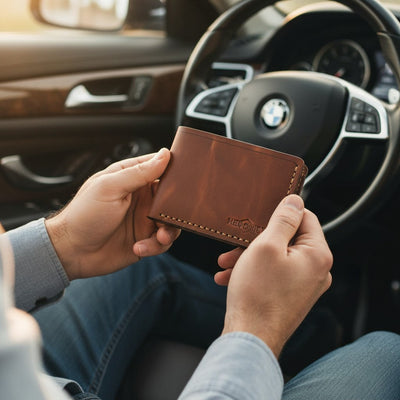
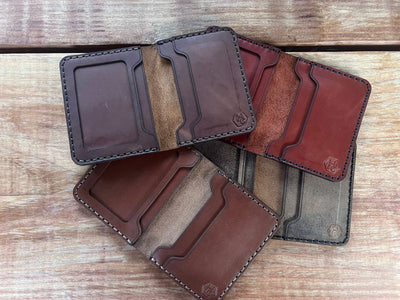
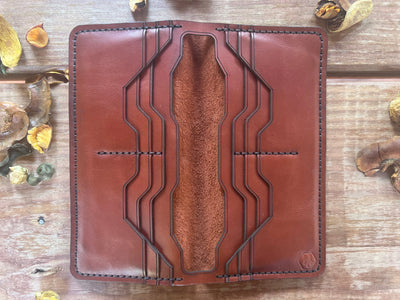
It's also why hand-stitched small leather goods take a craftsperson longer per item, relative to their size, than a belt does. A belt is mostly straight-line stitching. A compact card holder can have more stitched corners and pocket seams packed into it than a belt has across its entire length. The same construction logic carries over to handmade wallets, where multiple card slots and a bill compartment all meet at tight, overlapping seams.
"On a belt, one stitch drifting half a millimeter over forty inches is nothing. On a card holder, that same drift is the whole seam. We spend more time per square inch on a card holder than on almost anything else we make."
What Happens When a Stitch Actually Fails
The difference between saddle stitching and machine lockstitching matters most after the fact, when something has already gone wrong. A machine-stitched seam runs on a single continuous thread. If that thread snaps anywhere along the line, the stitches on either side of the break have nothing holding them in place, and the seam can unravel in both directions from that one point. On a belt, a few loose inches near a buckle is a nuisance. On a card holder pocket, that same failure mode can open the whole seam in one sitting.
Saddle stitching fails differently because each stitch is locked independently by two threads crossing inside the leather. Cut or wear through one stitch and the two threads on either side of it stay locked in place. The damage stays local instead of spreading down the line. That difference is also why a saddle-stitched seam can usually be spot-repaired by re-stitching a short section, while a machine-stitched seam that has started to unravel more often needs the whole line redone. On a piece the size of a card holder, where there is little spare leather to work with, that distinction affects how long the piece stays usable, not just how it looks new.
Corners and Hardware: The Other Details That Give Away Rushed Work
Stitching is the most visible tell, but it isn't the only place scale changes the standard. Corners are folded, skived, and burnished by hand on a small piece, and there's very little material to work with at each fold. A slightly uneven corner radius disappears on a belt tip. On a card holder, four corners sit within inches of each other, and any inconsistency between them is easy to spot side by side.
Hardware placement works the same way. A single buckle on a belt has one obvious axis to align. A handmade key chain or a luggage tag with a snap, rivet, or D-ring has to position that hardware so it sits centered and flat against a much smaller panel, with no long strap to visually absorb a slight misalignment. The smaller the piece, the less forgiving the layout, which is part of why these categories take longer to produce well than their size would suggest.
What to Check When You're Comparing Products
If you're weighing a hand-stitched small leather good against a cheaper machine-stitched one, the item's size is a reason to look closer, not less closely.
Start at the corners. On something small, uneven hand-stitching or rushed machine work shows up there first. Look at pocket edges under a light: puckering or uneven spacing will only get worse with use, because a small item has less material around the seam to absorb the stress. Check that hardware sits flush and centered rather than slightly off-axis. And ask about stitches per inch, along with the leather grade itself; our guide on how to spot real vs fake leather covers the grain-level details that matter just as much as the stitching on a small piece.
Our handmade card holders and leather belts are both saddle-stitched by hand from full-grain vegetable-tanned leather, but the stitching itself is doing a different job on each one.
Where the Same Standard Shows Up Across Small Leather Goods
Card holders aren't the only small format where this applies. The same tight corners, short seams, and close-set hardware show up on passport cases, key holders, and key chains, anywhere the finished piece is small enough that a stitching or corner flaw sits close to where a hand actually touches it. It's a big part of why we treat hand-stitching as a baseline across the full handmade leather goods line rather than reserving it for larger, higher-priced pieces where flaws are easier to miss.
The Short Version
A belt's length and width give it room to hide small imperfections. A card holder, key chain, or luggage tag has almost none. That's the real reason the craftsmanship bar for small leather goods ends up higher than for belts and larger pieces, even though the smaller item usually costs less. Hand-stitching earns its keep exactly where the margin for error is smallest, and it fails in a way that's easier to repair when it does eventually give out.
Over 2,500 verified customers have rated Hedonist Chicago leather goods an average of 4.78 stars, and the small hand-stitched pieces, card holders especially, are where that stitching quality shows up first. If you have questions about a specific piece, our contact page connects you directly with our team.
Leave a comment