What's the Best Leather Card Holder? A Buying Guide
There's no single best leather card holder brand, but a compact card holder is one of the easiest leather goods to judge on construction alone, since there's nowhere for flaws to hide. Full-grain leather, saddle-stitching, and hand-burnished edges separate a card holder that lasts a decade from one that loosens and frays within a year.
What to check before buying
| Feature | What it should look like | Why it matters |
|---|---|---|
| Leather grade | Full-grain, stated explicitly | Holds pocket shape and resists wear better than corrected-grain or bonded leather |
| Leather thickness | Roughly 1.5-2mm | Thin enough for pocket carry, thick enough to keep card slots from collapsing when empty |
| Stitching | Saddle-stitched with waxed thread | Interlocking stitches hold even if thread breaks at one point; a single machine seam can unravel entirely |
| Edges | Hand-burnished, not painted | Painted edges on a small, constantly-handled piece chip and peel within weeks |
| Pocket alignment | Even, symmetrical slots | A compact card holder has no room to disguise misaligned pockets the way a larger wallet might |
Why card holders reveal quality faster than wallets
A card holder is handled and flexed constantly, pulled in and out of a pocket dozens of times a day, and its small size means every stitch and edge is close to the eye. Construction problems that might take a year to show up on a larger bifold wallet tend to show up within weeks on a slim card holder. Our guide to why hand-stitching matters more on small leather goods covers this in more depth, since the same principle applies to any compact, frequently-handled piece.
Single-sided vs. bifold-style card holders
| Format | Typical capacity | Best for |
|---|---|---|
| Single-sided minimalist | 3-6 cards | Carrying only daily essentials, maximum slimness |
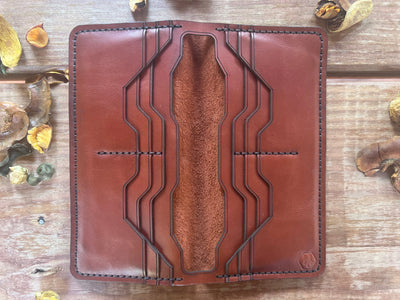
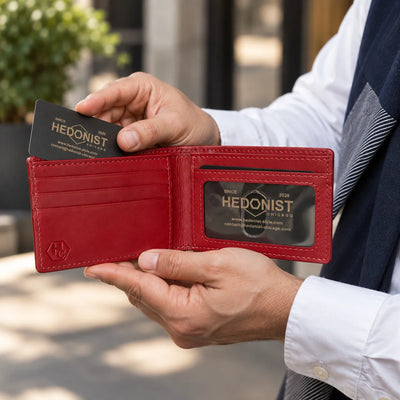
| Long or bifold-style card holder | 8-18 cards plus a center bill pocket | Replacing a full wallet while keeping a slim, streamlined profile |
The right format depends less on brand and more on how many cards you actually carry day to day. Buying a higher-capacity holder than you need adds bulk without benefit; buying one with too few slots means digging through a card stack that doesn't fit cleanly. Our guide to how many card slots you actually need covers how to figure out the right capacity for a card holder or a full wallet alike.
How to judge a card holder's construction from photos alone
- Zoom into any photo showing the stitching; consistent, evenly spaced stitches with visible waxed thread suggest hand or careful machine saddle-stitching, while gaps or uneven spacing suggest a rushed production line
- Look at the edge finish in a close-up shot; a smooth, slightly rounded, uniformly colored edge indicates hand-burnishing, while a flat, glossy, painted-looking edge often chips within weeks
- Check that card slots appear evenly spaced and symmetrical rather than visibly crooked, a detail that's hard to fix after the fact and easy to spot in a clear photo
Where Hedonist Chicago fits
Our handmade card holders use full-grain vegetable-tanned leather at 1.5 to 2mm, saddle-stitched with waxed thread and finished with hand-burnished edges, produced in small batches through artisan workshops rather than mass factory runs. They run $74 to $84 depending on card capacity (8 or 12 slots) and are built to last 10 to 15 years with basic care. Judge us, or any card holder brand, against the criteria above rather than the name on the listing.
Card holders and the search for the "best" wallet
People searching for the best thin wallet, the best slimline wallet, or simply the thinnest wallet they can find often end up comparing card holders and wallets side by side, and that's not a mistake. A well-built card holder is effectively the thinnest wallet format available, since it drops the folding bill pocket that adds bulk to any wallet design. If a search for the best leather wallet, the best leather billfold, or the best men's wallet keeps surfacing card holders in the results, it's because the same leather grade and stitching questions that separate a good billfold from a bad one apply identically here. The construction fundamentals don't change based on format, only the size and shape of the finished piece.
Where to actually buy one once you know what to look for
Card holders meeting these construction standards are sold through leather specialty shops and small direct-to-consumer makers more consistently than through department stores or general office suppliers, which tend to prioritize price over material grade. Our guide to where to buy a leather ID or business card holder covers the tradeoffs between these retail channels in more detail.
How card holder brands compare across price tiers
| Category | Typical price | What you're paying for | Typical leather grade |
|---|---|---|---|
| Mass-market fashion brand | $15-$35 | Design and low price, wide availability | Corrected-grain, bonded, or PU leather |
| Small-batch full-grain workshop | $50-$100 | Material quality and hand construction, sold direct to the customer | Full-grain, often vegetable-tanned |
| Heritage luxury brand | $150-$400+ | Brand name, retail packaging, and markup | Full-grain, sometimes top-grain |
Red flags that separate a marketing brand from a craft brand
- Vague material language. Listings that say only "leather" or "premium leather" without naming full-grain, top-grain, or genuine leather specifically are usually avoiding a grade that would not sound impressive.
- Stock photography with no real product shots. A brand selling actual full-grain, hand-stitched card holders can usually show close-up photos of the stitching and edge finish, since that construction photographs well and holds up to scrutiny.
- No stated country of tanning or manufacture. This does not by itself mean poor quality, but a brand confident in its supply chain is more likely to describe it than one that is not.
- Marketing language that leans entirely on heritage or story. Brand history is not a substitute for stating the leather grade and construction method plainly.
What a warranty or return policy tells you about a brand
A card holder brand's return and warranty terms are a useful, often overlooked signal of construction confidence. A brand offering a real return window and standing behind its stitching for a meaningful period is telling you, in practical terms, that it expects the product to hold up. A brand offering only final-sale terms with no warranty language at all, particularly at a price point that should support one, is a detail worth factoring into the decision alongside the construction checks above.
Questions to ask before ordering
- Does the listing name the leather grade specifically, not just "leather" or "genuine leather"?
- Is the stitching described as saddle-stitched or hand-stitched, versus simply "stitched" with no method named?
- What is the return or exchange policy if the construction doesn't hold up as described?
- Is personalization available, and does it add to the price or lead time?
Frequently asked questions
Is a thinner card holder always better?
Not necessarily. Leather thinner than about 1.5mm often can't hold card pocket shape when the holder is empty, which defeats the point of a minimalist design. The right thickness balances slimness with structure.
How many cards should a card holder hold?
Most people carrying 3 to 6 cards do well with a single-sided minimalist design; those wanting more capacity in a still-compact piece can look for 8 to 12-slot formats.
How long should a good leather card holder last?
A full-grain, saddle-stitched card holder with hand-burnished edges should hold up for 10 to 15 years of daily use with occasional cleaning and conditioning. A card holder failing within a year or two usually points to thin or low-grade leather and machine lock-stitching.
Does a higher price always mean better quality?
Not past a certain point. A well-built full-grain card holder in the $60-$90 range is often built the same way as a $200 version from a bigger brand name.
Can a card holder replace a full wallet entirely?
For many people, yes, especially the higher-capacity 8 to 18-slot formats with a center bill pocket. Whether it works as a full replacement depends on how many cards and how much cash you routinely carry.
Does personalization affect a card holder's durability?
Hot stamping and foil stamping, done correctly, press into the leather surface without weakening the material or the stitching, so a personalized card holder holds up the same as an unpersonalized one from the same construction.
Should I choose a card holder or a minimalist wallet?
A card holder with no bill pocket suits people who pay primarily by card and carry little or no cash; a minimalist wallet with a slim cash pocket suits anyone who still carries some bills regularly, even a small amount.
Does a well-known brand name guarantee better quality?
No. Brand recognition reflects marketing reach and history, not necessarily the materials or construction of a specific product. Two card holders from different brands can use identical leather grades and stitching methods at very different price points.
Is it worth paying extra for a heritage luxury brand's card holder?
Only if the specific construction details (leather grade, stitching method, edge finish) justify it against the criteria above. Many heritage brands do use full-grain leather and quality construction, but so do far less expensive small-batch workshops.
What is the best leather card holder to buy?
There isn't one single model that fits everyone. The best leather card holder for you comes down to full-grain leather stated explicitly, saddle-stitching with waxed thread, hand-burnished edges, and a slot count that matches how many cards you actually carry. Compare any card holder against those points before comparing price or brand name, and you'll land on the right one for your own pockets.
What is the best leather for a wallet or card holder?
Full-grain leather, ideally vegetable-tanned, is the best leather for a wallet or card holder. It holds shape under repeated flexing, develops an even patina with use, and resists the cracking that corrected-grain or bonded leather shows within a year or two. Thickness matters too: aim for roughly 1.5 to 2mm, thick enough to keep slots from collapsing but thin enough for comfortable pocket carry.
Is a card holder the best thin wallet option?
For most people who carry mostly cards and little cash, yes. A single-sided card holder is thinner than any folding wallet design can achieve, since there's no bill pocket or extra fold adding bulk. If you regularly carry cash, a slim bifold-style card holder with a center bill pocket is a better fit than a true minimalist card holder.
Updated: September 28, 2026
Related reading
For more on what sets hand-stitched pieces apart, see our handmade card holders guide and why hand-stitching matters more on small leather goods. Browse our handmade leather card holders.
Leave a comment