



Does a Leather Wallet Need RFID-Blocking Protection?
Quick answer: most people do not strictly need an RFID blocking wallet. Modern contactless cards use encrypted, single-use codes, and real-world skimming through a wallet is uncommon. RFID-blocking lining is still a reasonable permanent extra: a thin metal layer behind the card slots that adds no visible thickness and needs no upkeep. Treat it as a small bonus, not a reason to choose one wallet over another.
| Card or document | Uses RFID/NFC | Realistic risk without shielding |
|---|---|---|
| Contactless debit or credit card | Yes | Low: a reader must be within 1 to 2 inches, and modern cards use encrypted single-use codes |
| US or EU e-passport | Yes | Low: encrypted chip, short read range |
| Hotel or office key card | Sometimes | Depends on the building's own system |
| Magnetic-stripe-only card | No | None, nothing to skim by radio |
Picks to go with this guide

Men's Black Slim Bifold Leather Wallet
0.5" profile, 6-12 cards, ID window, RFID lining
View product →
Black Croco Slim Leather Bifold Wallet for Men
6-12 cards, ID window, RFID lining, 0.5" profile
View product →
Slim Red Leather Bifold Wallet for Men with ID Slot
6-12 cards, RFID lining, 0.5" profile
View product →Do You Need an RFID Blocking Wallet?
For most people the practical risk is low. A contactless card carries a chip and an antenna coil but no battery. It only responds when a reader within a few centimeters powers it, and the transaction uses an encrypted, single-use code, so a stranger with a hidden reader cannot simply pull your card number out of the air. That is why RFID blocking is best thought of as a small extra layer, not a necessity.
It is still worth having if you carry contactless cards often, travel through crowded transit hubs, or simply want one less thing to think about. Because the shielding is built into the lining, it adds no bulk and costs you no convenience once you own the wallet.
How RFID and NFC Work in a Payment Card
A contactless card is passive. When a compatible reader comes close, it generates a radio field that powers the chip just long enough to exchange an encrypted transaction code. Standard contactless payment cards operate at 13.56 MHz, the same band used by NFC in phones, and the reliable read range is under two inches even with purpose-built hardware. A card in a back pocket is not broadcasting anything to a passer-by the way some marketing for blocking products implies. It only responds when a reader's field actively powers it.
Is RFID Skimming a Real Risk?
Early contactless and magnetic-stripe cards sent static data, so a captured signal could be reused. EMV chip technology changed that by generating a fresh cryptographic value for every transaction, so a captured code from one purchase is useless for a second one. That shift did more to close off realistic skimming than any wallet accessory. Older unencrypted cards and a few legacy transit or access cards are the main exceptions.
Large-scale skimming of modern contactless cards through a pocket or bag has not been widely documented outside controlled security research. Most publicized card fraud involves stolen physical cards, phishing or data breaches, which criminals prefer because they scale with far less risk. Shielding does nothing against any of those, so it should not be treated as a primary defense against card fraud.
How an RFID Blocking Leather Wallet Works
An RFID blocking leather wallet is a normal wallet with a thin layer of metal mesh or foil built into the lining behind the card slots. The layer absorbs and reflects the 13.56 MHz field a reader emits, so the field never reaches the chip with enough strength to power it. It has no battery and no moving parts, so there is nothing to wear out, and a wallet either has it from the start or it does not. The principle is related to a Faraday cage, but it is a lighter-weight version aimed at the one band contactless cards and passports use.

RFID Blocking Wallet vs Sleeves and Blocking Cards
| Option | How it works | Trade-off |
|---|---|---|
| Wallet with blocking lining | Metal mesh built permanently into the card compartment | No extra step, nothing to lose or forget |
| Blocking sleeve per card | A foil sleeve for each card | Blocks one card fully, but you must sleeve every card |
| Blocking card in the wallet | A shielding insert among your cards | Coverage depends on positioning, less reliable than lining around the whole compartment |
How to Check If a Wallet Has RFID Protection
- Read the product description for the words "RFID-blocking" or "RFID shielding" instead of assuming a slim or minimalist design includes it.
- Look for the lining behind the card slots in photos of the open wallet.
- Hold a contactless card inside the wallet against a payment terminal. With working shielding the read fails, and without it the payment goes through. You still take the card out to pay normally.
Our Wallets With RFID-Blocking Lining
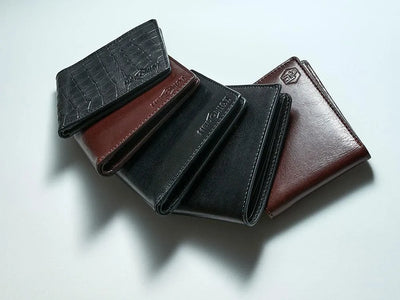
Our slim bifold wallets with a clear ID window (Black Croco, Black, Brown and Red) build RFID-blocking lining directly behind the card slots, inside a folded profile of about 0.5 inch. The lining sits invisibly under the leather, so the wallet carries like any other slim bifold. To match capacity to your carry, read how many card slots you need, and see the slim wallet guide and the RFID wallets for women guide for more formats. Our leather wallet brand buying guide covers what else to check on a listing.
| Question | Answer |
|---|---|
| Does it protect a passport too? | Only if the passport is inside the shielded compartment, not just carried nearby |
| Does it affect Apple Pay or Google Pay? | No, phone payments use a different authentication process |
| Can the shielding wear out? | No, it is a physical metal layer, not a coating or a battery |
| Could it block my hotel key or office badge? | Yes, if the card is inside the shielded slot. It works again once removed |
Who Benefits Most From RFID-Blocking Lining
Frequent travelers, people who keep a passport next to contactless cards, and anyone who wants fewer things to worry about get the most practical value. It is a reasonable permanent precaution rather than a necessity, like a seatbelt on a short drive: low odds on any trip, near-zero cost once it is built into a product you were already buying.
What RFID Blocking Does Not Protect Against
Shielding does nothing for online card-not-present fraud, phishing, merchant or bank data breaches, or a stolen card used directly. Those account for most real payment fraud, which is why RFID blocking is a small, no-cost extra and not a broad security feature.
Free Personalization and Where to Start
Every wallet we make can be personalized at no charge, with initials, a name or a short phrase of up to 40 characters. See the personalization page for details. To choose a format, start with the men's leather wallet guide, then browse our slim wallets or the full men's wallet collection.
More picks from the same range

Men's Slim Brown Leather Billfold Wallet
6-12 cards, RFID lining, 0.5" profile
View product →
Slim Brown Leather Bifold Wallet for Men with ID Slot
6-12 cards, RFID lining, 0.5" profile
View product →
Slim Dark Brown Leather Minimalist Wallet for Men
6-12 cards, ID window, RFID lining, 0.5" profile
View product →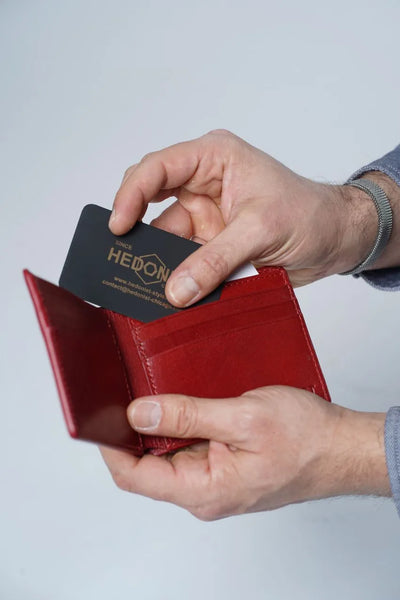

Leave a comment