



Wallet Size Guide for Men: Standard Dimensions by Wallet Type
Quick answer: the standard wallet size for men is about 4.3 x 3.5 inches (11 x 9 cm) folded for a bifold. The average wallet size runs from 3.5 x 2.4 inches for a card holder to 7.5 x 3.5 inches for a long wallet. A slim bifold is about 4.1 x 3.0 inches and roughly 0.5 inch (13 mm) thick with a normal card load. If a wallet feels too big, the cause is usually thickness from too many cards, not the outer dimensions.
| Wallet type | Closed size (W x H) | Thickness, normal load | Cards | Best pocket |
|---|---|---|---|---|
| Card holder / minimalist | 3.5 x 2.4 in (89 x 61 mm) | 0.2 to 0.35 in (5 to 9 mm) | 2 to 5 | Front |
| Slim bifold | 4.1 x 3.0 in (104 x 76 mm) | 0.5 in (13 mm) | 6 to 12 (daily 4 to 6) | Front or back |
| Standard bifold | 4.1 to 4.3 x 3.3 to 3.5 in (104 to 109 x 84 to 89 mm) | 0.5 to 0.75 in (13 to 19 mm) | 6 to 12 | Back or jacket |
| Long wallet / long card holder | 3.5 x 7.5 in (89 x 191 mm) | 0.5 to 0.75 in (13 to 19 mm) | 8 to 12+ | Jacket or bag |
Card holder and standard bifold rows are typical market ranges. Slim bifold and long card holder rows are the measurements of our own men's wallets. Sizes are for the wallet folded or closed, with a normal card load.
Picks to go with this guide

Red Leather Bifold Wallet for Men
6-12 cards, RFID blocking, flat bill section
View product →
Men's Black Slim Bifold Leather Wallet
0.5" profile, 6-12 cards, ID window, RFID lining
View product →
Green Croco Leather Bifold Wallet for Men
6-12 cards, RFID blocking, croco-embossed texture
View product →What Is the Standard Wallet Size for Men?
There is no official standard, but one fixed number sets the floor. Every bank card, driver's license and membership card follows the ID-1 format, 3.37 x 2.13 inches (85.6 x 54 mm). A wallet has to be wider and taller than that to hold a card at all, which is why almost every bifold lands between 4 and 4.5 inches wide and 3 to 3.5 inches tall when folded. That range is the average wallet size most men carry.
Open, a bifold is about twice as wide, 8 to 9 inches. A US bill measures 6.14 x 2.61 inches (156 x 66 mm), so it folds once to sit inside a bifold. Only a long wallet, with a height of about 7.5 inches, holds bills flat.
Our bifold wallets are 4.1 inches wide and 3.0 to 3.3 inches tall, and 0.5 inch deep when folded. Our compact six-slot bifold measures 3 x 4.1 inches folded and holds up to 6 cards. Our long card holders measure 7.5 x 3.5 x 0.5 inches and hold 8 to 12 or more.

Wallet Sizes by Format: Dimensions of Each Type
Each format trades width and capacity against thickness. Pick the format first, then check that the wallet dimensions fit your pocket.
Slim wallets keep the footprint close to a card (about 3.5 x 2.4 inches for a card holder, 4.1 x 3.0 inches for a slim bifold). The gain is thickness, not height or width. Our slim wallets stay at 0.5 inch folded, which is the thickness most men can carry in a front pocket without an outline showing through jeans.
Standard bifolds add an inch of height at most, and the extra thickness comes from card slots and a bill section. A bifold loaded to 8 cards plus a few bills usually measures 0.6 to 0.75 inch. This works in a back pocket or jacket, and in a front pocket for many men.
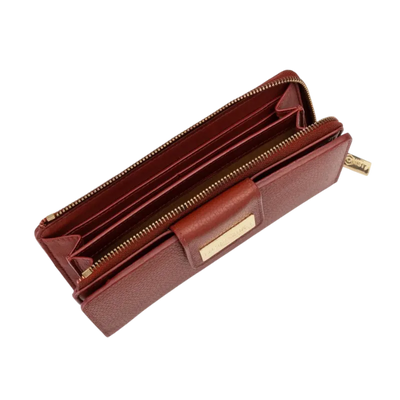
Long wallets are tall rather than thick. At 7.5 inches high, they will not fit a front pocket or most back pockets, and they sit best in a jacket pocket or bag. The benefit is flat, unfolded bills and room for 12 or more cards.

For a full comparison of what each format does well, see our bifold wallet guide and slim wallet guide.
How Thick Should a Wallet Be?
Thickness matters more than width. A 4.1-inch wallet that is 0.5 inch thick feels very different from the same wallet at 1 inch. These are practical limits for a wallet loaded with your real daily carry:
| Carry position | Comfortable | Tolerable | Too thick |
|---|---|---|---|
| Front pocket | Up to 0.5 in (13 mm) | 0.5 to 0.7 in | Over 0.7 in (18 mm) |
| Back pocket | Up to 0.75 in (19 mm) | 0.75 to 1 in | Over 1 in (25 mm) |
| Jacket pocket | Up to 1 in (25 mm) | 1 to 1.25 in | Over 1.25 in |
Measure the wallet with your real cards and bills in it, not empty. A wallet that is 8 mm empty and 15 mm loaded is a 15 mm wallet. If yours is over the limit for your pocket, remove cards before you replace the wallet. Our guide on thin vs regular wallets covers how thickness changes everyday carry in more detail.
How to Measure a Wallet
You only need a ruler or tape measure and about two minutes.
- Close the wallet and lay it flat on a table with the fold on the left.
- Measure the width from the fold to the right edge, then the height from top to bottom.
- Stand the wallet on its edge, or press it gently flat, and measure the thickness at the fold. This is the number that matters for pocket fit.
- Measure your pocket too. Slide a ruler into the pocket and note the depth. A wallet taller than the pocket depth minus about half an inch will stick out.
When you shop online, compare these numbers with the "folded" dimensions on the product page. Each of our wallets lists folded width, height and depth.
How Many Cards Fit at Each Wallet Size?
Card count decides which wallet size works. A card is about 0.03 inch (0.8 mm) thick, so ten cards add roughly a third of an inch before leather and bills. Most men carry four to six cards every day. Use the table to match that count to a size:
| Daily card count | Best size | Why |
|---|---|---|
| 2 to 4 | Card holder or slim bifold | Keeps thickness near 0.35 to 0.5 in |
| 4 to 6 | Slim bifold | Fits a front pocket and holds cash folded once |
| 6 to 8 | Standard bifold | Each card keeps its own slot |
| 8 to 12+ | Long wallet or long card holder | Spreads cards across a wider surface |
Not sure what your own count is? Our guide to how many card slots you need shows a quick way to find it. For a choice based on habits instead of dimensions, start with the men's wallet guide.

What Happens If You Choose the Wrong Size
A wallet that is too small for your carry stretches. Card slots loosen, cards slide out, and the leather bulges in the middle. A wallet that is too large for your carry feels empty and loose, and it adds pocket bulk you do not need. Aim to fill a wallet to about 80 percent of its card capacity. That leaves room for a receipt or an extra card without distorting the shape.
Leather quality changes how a wallet holds its size. Full-grain vegetable-tanned leather softens and keeps its shape, while weaker leathers stretch and stay stretched. Our men's leather wallet guide explains what to look for.
Sizing Tips for Specific Situations
Travel. Trips add boarding passes, a second card and a bit of foreign cash. A standard bifold or a long wallet handles that better than a slim wallet. Keep a slim wallet for daily use and switch only on trips.
Gifts. If you do not know how many cards he carries, a standard bifold at 4.1 inches wide is the safest size. It fits most pockets and holds more than most men use. Add a free monogram and it becomes a gift that belongs to one person (details below).
Tight trousers. Choose by thickness first. Stay at or below 0.5 inch loaded, and expect to carry no more than five cards.
Free Personalization on Every Wallet, in Every Size
Every men's wallet we make can be personalized at no charge, whatever its size. Slim bifold, standard bifold, long card holder and compact six-slot wallet all take the same free monogram. There is no minimum order and no extra fee for any option.
To add it, click Add Free Monogram on the product page before you add the wallet to your bag. A popup opens where you type your text and pick a finish. The request goes into production with your order, with no forms and no follow-up emails.
You can choose from five finishes: hot stamping (a clean debossed impression with no foil), or gold, silver, black or white foil. Gold works well on brown and tan leather, silver and white give strong contrast on dark leather, and black foil suits any color. The text is set in Goudy Cursive 18 pt in the inside right corner and can run up to 40 characters including spaces. That is enough for initials such as J.D., a full first name, a date, a short phrase like "To My Love", or a set of coordinates.
Size matters for personalization in one practical way. The stamp sits inside the wallet, so it works the same on a 3.5-inch card holder as on a 7.5-inch long wallet, and it never changes the outer dimensions or the thickness. The stamp is pressed into full-grain leather and is permanent, so check spelling before you order. Personalized orders usually ship the next business day, and always within 2 business days. It ships in a branded gift box.
Because it costs nothing extra, a monogram is the easiest way to turn a well-sized wallet into a gift for a groomsman, a father or a graduate. Full details, examples and placement are on the personalization page.
Which Wallet Size Should You Choose?
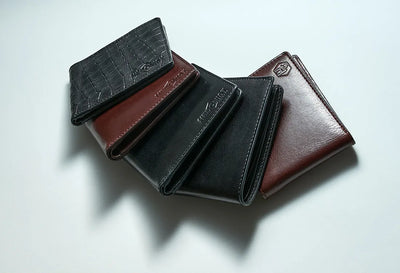
Count the cards you used this week, measure your pocket, and match them to the tables above. For most men, that points to a slim bifold or a standard bifold. Browse the full men's wallet collection or start with our best sellers if you want a proven size. To compare formats before you decide, read slim wallet vs bifold.
More picks from the same range

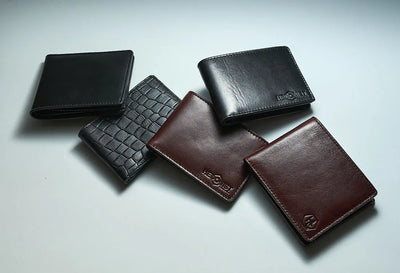
Men's Black Leather Bifold Wallet
6-12 cards, flat bill section, RFID blocking, 0.5" profile
View product →
Dark Brown Leather Bifold Wallet for Men
6-12 cards, RFID blocking, flat bill section
View product →
Black Croco Slim Leather Bifold Wallet for Men
6-12 cards, ID window, RFID lining, 0.5" profile
View product →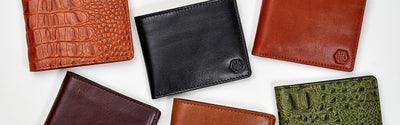
Leave a comment