



Who Invented the Ratchet Belt, and What Brand Should You Buy?
Quick answer: No single person is credited with inventing the ratchet belt as we know it today. The underlying ratchet mechanism traces back to a cargo-strap patent filed by French engineer Gustave A. Audiffren in the early 1900s, which the French military adopted for securing transported goods using a hand-cranked metal ratchet. The specific toothed-track, spring-loaded-pawl design used in modern ratchet belt buckles was patented decades later, including a 1995 patent by inventor Soon-Myung Ko for a belt buckle using a toothed strap and a releasable pawl, the same basic mechanism belts use today.
A brief timeline
| Period | Development |
|---|---|
| Early 1900s | Gustave A. Audiffren patents a hand-cranked ratchet mechanism for securing cargo straps |
| 1980s-1990s | Several inventors, including Soon-Myung Ko in 1995, patent toothed-track and spring-loaded-pawl mechanisms adapted specifically for belt buckles |
| 2000s-2010s | Ratchet belts using this mechanism become widely available as a mainstream men's and women's accessory |
Picks to go with this guide

Black Leather Dress Ratchet Belt with Silver Frame Buckle - 1.15"
Slim dress trouser fit, micro-adjustable, interchangeable buckle
View product →
Black Leather Casual Ratchet Belt with Gunmetal Hollow Rectangle Buckle - 1.38"
Micro-adjustable fit, interchangeable buckle
View product →
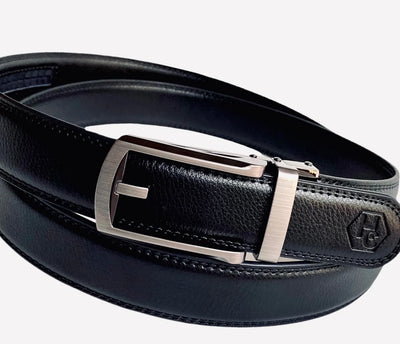
Black Leather Ratchet Belt with Open Frame Buckle - 1.38"
Micro-adjustable fit, interchangeable automatic buckle
View product →A closer look at the patent history
Patent filings from the 1980s through the late 1990s show a cluster of independent inventors working on variations of the same basic problem: how to let a belt buckle tighten in small increments without holes, while still releasing cleanly when needed. Several of these early patents describe mechanisms very close to what ships in a modern ratchet belt today: a toothed strap, a spring-loaded catch, and a lever release, filed by different inventors in different countries within a few years of each other. This kind of parallel invention is common with mechanical designs that solve a widely felt problem once the necessary manufacturing precision becomes affordable.
Since there's no single inventor to credit, how do you choose a brand?
Because the ratchet mechanism itself isn't proprietary to any one company, the meaningful difference between brands comes down to how well each one executes the pawl, spring, and track, not who came up with the idea first.
| What to check | Why it matters |
|---|---|
| Pawl material | Hardened steel holds its shape under repeated engagement; softer metal wears down and starts slipping |
| Spring quality | A properly tempered spring keeps consistent tension for years; a weak one loses tension within months |
| Leather grade and thickness | Solid full-grain or top-grain leather at roughly 3.5-4.5mm holds the track shape without the layers separating |
| Buckle housing | A rigid housing keeps the pawl aligned with the track; a housing that flexes causes inconsistent engagement |
Where Hedonist Chicago fits
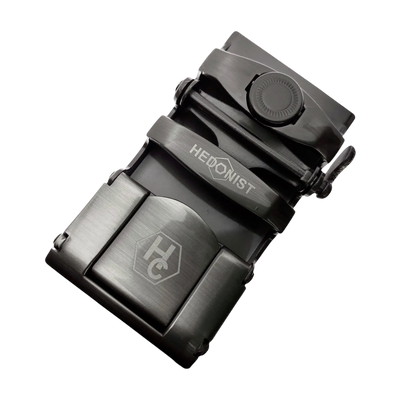
Our ratchet belts have a top-grain cow leather strap with the ratchet track inside the strap, and a detachable, swappable buckle. Belts run $44, and personalization is free. We are one of many brands building on the same decades-old mechanism, so check the criteria above against any belt you are considering, ours included, rather than taking a brand name as a shortcut for quality.
Why the ratchet mechanism took decades to reach belts
Cargo-securing ratchets in the early 1900s were built from heavy metal components sized for straps hauling freight, not for something worn against skin all day. Miniaturizing the mechanism down to a size and weight comfortable for daily wear required precision metalworking that only became widely affordable in the later 20th century, which is why the gap between the original cargo-strap patent and the first belt-specific patents spans most of a century. Once the mechanism could be produced small, light, and consistent enough for a belt buckle, adoption across the fashion industry happened relatively quickly through the 2000s and 2010s.
How ratchet belts compare to the belts they replaced
A traditional belt's fixed holes, spaced roughly an inch apart, mean a wearer is often stuck between a setting that's slightly loose and one that's slightly tight. The ratchet track's quarter-inch increments solve that problem directly, which is largely why adoption spread once the mechanism became affordable to manufacture at scale. Our guide to how a ratchet belt buckle actually works breaks down that mechanism in detail.
Reading a brand's marketing claims critically
Marketing copy for ratchet belts often leans on words like precision-engineered, military-grade, or heavy-duty without defining what those terms mean in materials or testing. None of these phrases are regulated, so they tell you very little on their own. A brand that instead states the specific metal used for the pawl and spring, the leather grade and thickness, or a cycle-tested durability figure is giving you something you can actually evaluate against a competitor's listing.
Price tiers and what they typically reflect
| Price range | What that usually buys |
|---|---|
| Under $20 | Often corrected-grain or bonded leather with an unspecified, frequently lower-grade buckle mechanism |
| $35-$60 | Solid full-grain or top-grain leather at a reasonable thickness, paired with a hardened steel mechanism from a brand willing to state its materials |
| $75+ | Often the same core materials and mechanism as the mid-tier, priced up for brand recognition or additional finishing details |
Evaluating a brand you haven't heard of before
A newer or lesser-known brand isn't automatically a red flag, since ratchet belt manufacturing doesn't require decades of history to execute well. Look at whether the listing specifies leather grade and thickness, describes the buckle's pawl and spring material, offers a real return or warranty policy, and includes close-up photography of the stitching and buckle housing rather than only styled lifestyle shots. A brand meeting most of these criteria is a reasonably safe bet regardless of how long it's been around.
Frequently asked questions
Are ratchet belt mechanisms patented, so all belts are basically identical?
The core idea is not exclusive to one company, since the toothed-track and pawl concept has been patented and re-patented in various forms since the 1980s and 1990s. Specific pawl shapes, housing designs, and manufacturing tolerances still vary a lot between brands, which is what actually affects how well a given belt performs.
Why do some ratchet belts fail within months while others last for years?
This almost always comes down to manufacturing quality on the pawl and spring, not the ratchet concept itself. A hardened, properly tempered mechanism holds up for years; a cheaper one wears down or loses tension within just a few months of regular use.
Was the ratchet belt originally a military design?
Not directly. The ratchet principle used in belts descends from cargo-strap and tie-down mechanisms, some of which the French military adopted for securing transported goods, but the belt-specific application came later through separate civilian patents adapting that mechanism for personal wear.
Is the ratchet mechanism used in anything besides belts today?
Yes. The same track-and-pawl principle appears in cargo tie-down straps, some watch bands, and various tensioning tools, since a mechanism that tightens in small increments and holds firmly under load until deliberately released is genuinely useful well beyond belts.
Why did ratchet belts take so long to become mainstream after the mechanism was patented?
Manufacturing a scaled-down, reliable version of the mechanism affordably at high volume took time to develop, and consumer awareness of the format also had to build before it became a mainstream menswear and womenswear staple through the 2000s and 2010s.
What does "military-grade" actually mean on a ratchet belt listing?
Usually nothing specific, since it isn't a regulated or standardized term for consumer accessories. Treat it as marketing language rather than a meaningful quality claim, and look instead for stated leather grade, buckle materials, and any published cycle-testing data.
Should I trust a new, unfamiliar brand selling a ratchet belt?
Brand history matters less here than specific, checkable claims: stated leather grade and thickness, described buckle materials, a real return policy, and genuine product photography. A newer brand meeting those criteria is just as reasonable a choice as an established name.
How do I buy a good leather belt?
Check four things before buying: the leather grade and thickness, the pawl and spring metal, whether the buckle housing feels rigid rather than flexible when you tighten it, and whether the seller states any of that plainly rather than relying on vague marketing terms. A belt that checks all four is a safe purchase regardless of brand recognition.
What is the best leather belt to buy?
There's no single best belt, since the right one depends on your budget and how you plan to wear it. In general, solid full-grain or top-grain leather at 3.5-4.5mm thickness paired with a hardened steel pawl and a tempered spring, usually found in the $35-$60 range, gives you the most durability for the money.
Where can I buy leather belt straps separately from a buckle?
Most ratchet belt brands, including ours, sell straps and buckles as separable parts specifically so a worn buckle or a strap that needs trimming doesn't mean replacing the whole belt. Check the brand's own site first, since a strap sold on its own needs to match the width and track spacing of your existing buckle. Ours are in the ratchet belt straps collection.
Updated: October 8, 2026
More picks from the same range

Black Leather Ratchet Belt with Silver Buckle - 1.38"
Micro-adjustable fit, interchangeable automatic buckle
View product →
Black Leather Ratchet Belt with Black Plate Buckle - 1.38"
Micro-adjustable, interchangeable buckle
View product →
Dark Brown Leather Ratchet Belt with Polished Silver Buckle - 1.38"
Micro-adjustable, interchangeable buckle system
View product →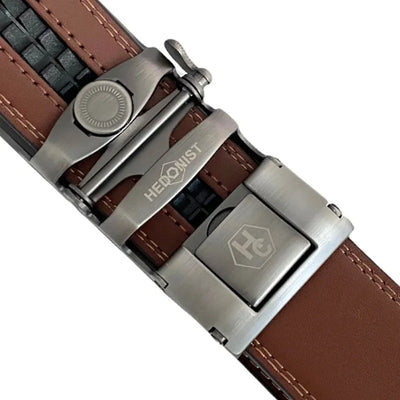

Leave a comment