



Does a Leather Belt Stretch Over Time?
Quick answer: A leather belt does loosen slightly during its first weeks of wear as the fibers relax around your waist and the fold at the buckle softens. That small amount of give is normal break-in, not a defect. A belt that keeps stretching well past that point, or sags and loses its shape, usually points to thin or low-grade leather rather than ordinary aging.
Normal break-in vs. a belt that's actually failing
| What you notice | Normal break-in | Actual problem |
|---|---|---|
| Timeline | First few weeks of regular wear | Continues gradually for months with no leveling off |
| Where it happens | Even softening across the fold at the buckle | Stretching concentrated at the buckle attachment or a specific hole |
| Shape | Belt lies flat and holds its curve | Belt develops a permanent warp or won't lie flat |
| Holes | Stay round and hold the pin securely | Holes elongate, tear, or develop cracks radiating outward |
Picks to go with this guide

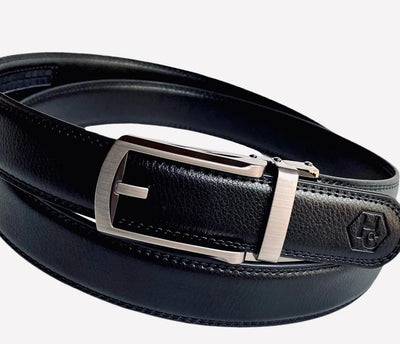
Black Leather Dress Ratchet Belt with Silver Frame Buckle - 1.15"
Slim dress trouser fit, micro-adjustable, interchangeable buckle
View product →
Black Leather Casual Ratchet Belt with Gunmetal Hollow Rectangle Buckle - 1.38"
Micro-adjustable fit, interchangeable buckle
View product →What actually causes permanent stretching
- Thin or corrected-grain leather: leather without enough fiber density gives way under the constant tension a belt holds all day and doesn't spring back
- Weak stitching at the buckle attachment: this junction carries the full tension of the belt system, and a single row of stitching here is the most common point where cheaper belts fail first
- Unreinforced holes: without a metal grommet or properly finished edge, the leather around each hole gradually tears and enlarges from repeated pin insertion, a problem covered in more detail in how to add a hole or replace the buckle on a leather belt
- Consistently overtightening: routinely buckling a belt tighter than its natural resting tension stresses the same fold line repeatedly
Why full-grain, vegetable-tanned leather resists this better
Full-grain leather keeps the hide's original outer fiber layer intact, which is the densest and most tension-resistant part of the skin. At 3.5 to 4.5mm of thickness, it holds its shape at the buckle fold and around the holes instead of gradually giving way. Corrected-grain and bonded leather have already had that dense surface layer removed or compromised, so they stretch further under the same daily tension and don't recover.
What to check before you buy
| Feature | What it should look like |
|---|---|
| Buckle attachment | Multiple rows of stitching, not a single line, at the point of maximum stress |
| Holes | Reinforced with metal grommets or cleanly finished edges that resist tearing |
| Leather thickness | Roughly 3.5-4.5mm for a standard dress or casual belt |
| Leather grade | Full-grain, ideally vegetable-tanned, stated explicitly in the listing |
How belt tension actually works against the leather
A belt spends most of its working life under mild, constant tension rather than sudden force, since it's holding steady pressure against your waist for as many hours as you wear it. That sustained load is different from the brief flex of, say, a wallet fold, and it's why leather thickness and fiber density matter more for belts than for many other leather goods. A belt cut from leather too thin for that sustained tension will show creep (a slow, permanent lengthening) well before it shows any other visible sign of wear. This is also why getting the length right from the start matters; a belt sized correctly, as covered in how to measure your belt size, spends its life closer to the middle of its comfortable range rather than constantly under maximum tension at the tightest hole.
What to do if you notice early stretching
- Check whether the stretching is concentrated at one point (the buckle attachment or a single hole) rather than distributed evenly, since concentrated stretching points to a specific weak spot rather than general leather quality
- Give the belt a rest between wears rather than wearing the same one daily, which allows the leather to recover some tension between uses
- Avoid punching a new hole immediately at the first sign of looseness; a few days of rest sometimes resolves minor post-break-in slack on its own
How this compares to why leather wallets stretch or sag
The underlying mechanism is the same one that causes a leather wallet to lose its shape over time: leather fibers relax under sustained load and don't fully rebound once pushed past their structural limit. Our guide to does a leather wallet stretch or sag over time covers that in more detail if you're seeing similar issues with other leather goods, not just a belt.
Does the buckle type affect how much a belt stretches?
Not directly, since stretching is a property of the strap leather rather than the buckle mechanism attached to it. A ratchet belt and a traditional pin-buckle belt made from the same leather grade and thickness will stretch at roughly the same rate under the same conditions. Where buckle type does matter is at the point where it attaches to the strap: a ratchet belt's track absorbs a small amount of stretch more gracefully through its quarter-inch adjustment range, while a pin-buckle belt relies entirely on moving to a different hole once stretching changes the fit.
Can you stretch a leather belt on purpose?
Yes, within a limited range. Working a leather conditioner into the strap softens the fibers slightly and lets the belt take a bit more give at the fold, and wearing a slightly tight belt for short stretches at a time lets normal break-in do the rest over a week or two. This only buys you a small amount, roughly the difference between two adjacent holes, not a full size. A belt that needs more room than that should go up in length rather than being stretched past what the leather can safely take.
Frequently asked questions
Is it normal for a new leather belt to feel stiff and then loosen up?
Yes. New full-grain leather starts stiffer than it will feel after a few weeks of wear, since the fibers haven't relaxed around your waist yet or at the fold by the buckle. That initial loosening is normal break-in, not a sign of poor quality, and it typically levels off within the first month of regular use.
Can a stretched-out belt be fixed?
Not fully. Once leather has stretched past its structural limit, it doesn't shrink back to its original size on its own. Punching a new hole to tighten the fit can compensate for moderate stretch, but a belt that's badly warped or torn at the holes generally needs replacing.
Does storing a belt flat instead of hanging it prevent stretching?
Not really, since storage mainly affects shape rather than stretch itself. Hanging a belt on a hook or coiling it loosely keeps it from developing the sharp permanent creases that come from folding it tightly or storing it flat under weight. That's a separate problem from tension-related stretching, which comes from wear, not storage position.
Do wider belts stretch less than narrow ones?
Not on their own. Width doesn't determine how much a belt stretches; leather grade and thickness matter far more. A wide belt cut from thin, corrected-grain leather will still stretch and sag, while a narrower belt built from full-grain leather at proper thickness, around 3.5 to 4.5mm, holds its shape just as well or better.
Does humidity make a leather belt stretch faster?
Indirectly, yes. Moisture softens leather fibers temporarily, which makes them easier to deform under the steady tension a belt carries all day. A belt worn regularly in hot, humid climates is more likely to show early stretching than the same belt worn somewhere dry, even if both are the same leather grade and thickness.
Does a ratchet belt stretch the same way a pin-buckle belt does?
Yes, the strap material behaves the same way regardless of buckle type, since stretching is a property of the leather itself, not the mechanism attached to it. Where the two differ is in how they absorb it: a ratchet belt's track can take up minor stretch through its quarter-inch adjustment range, while a pin-buckle belt only compensates once you move to a different hole.
Does a belt stretch faster if it's worn every single day?
Generally yes, since more hours under tension means more cumulative stress on the fibers. Alternating between two belts, similar to rotating shoes or wallets, gives each one recovery time and can extend how long it holds its shape.
Do leather belts stretch over time?
Slightly, yes. A leather belt loosens a small amount during its first weeks of wear as the fibers settle at the buckle fold, then holds steady after that. Continued stretching well past the break-in period usually means the leather is thinner or lower grade than it should be, not that stretching over time is normal for a well-made belt.
How much does a leather belt stretch?
A well-made full-grain belt typically stretches the equivalent of about half a hole to one hole during normal break-in, then stops. Lower-grade or thin leather can keep stretching well beyond that, sometimes multiple hole-widths over a year of regular wear, which points to the material rather than expected behavior.
How do I stretch a leather belt that feels too tight?
Condition the strap with a leather conditioner to soften the fibers, then wear it buckled at your desired tightness for a few hours at a time over a week or two. This typically gains you the equivalent of one hole's worth of room. If you need more space than that, the belt is likely the wrong length, and stretching it further risks damaging the leather.
Updated: October 8, 2026
For a look at how much reinforcement and thickness actually cost, see our guide to extra-durable leather belts. Browse our leather belts if you are choosing a new one.
More picks from the same range

Black Leather Ratchet Belt with Open Frame Buckle - 1.38"
Micro-adjustable fit, interchangeable automatic buckle
View product →
Black Leather Ratchet Belt with Silver Buckle - 1.38"
Micro-adjustable fit, interchangeable automatic buckle
View product →
Black Leather Ratchet Belt with Black Plate Buckle - 1.38"
Micro-adjustable, interchangeable buckle
View product →

Leave a comment