



How Much Should a Good Leather Belt Cost?
Quick answer: A genuinely well-made leather belt, full-grain, properly stitched at the buckle, with reinforced holes, typically costs $40 to $90. Belts under $25 are almost always corrected-grain, bonded, or PU leather. Belts over $150 from name brands often use the same leather grade and construction as the $40 to $90 tier, with the difference going to brand markup rather than materials.
What you're paying for at each price point
| Price range | What that usually gets you |
|---|---|
| Under $25 | Bonded or corrected-grain leather, single-line machine stitching, unreinforced holes that tend to tear |
| $40-$90 | Full-grain, often vegetable-tanned leather at 3.5-4.5mm, reinforced stitching at the buckle, grommeted or properly finished holes |
| $150+ | Frequently the same leather grade and construction as the $40-$90 tier, priced up for brand name and retail markup |
Picks to go with this guide
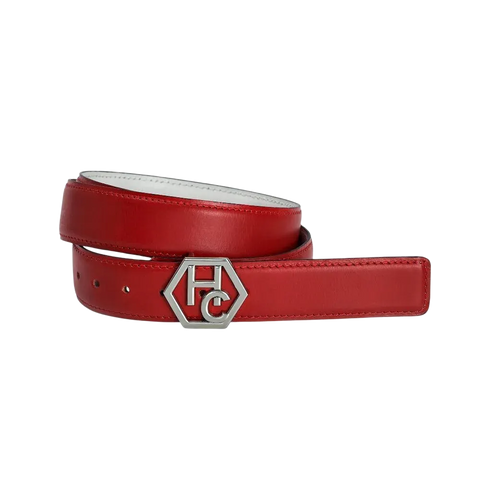

Black Leather Dress Ratchet Belt with Silver Frame Buckle - 1.15"
Slim dress trouser fit, micro-adjustable, interchangeable buckle
View product →
Black Leather Casual Ratchet Belt with Gunmetal Hollow Rectangle Buckle - 1.38"
Micro-adjustable fit, interchangeable buckle
View product →Why the buckle attachment and holes matter more than people expect
A belt's buckle attachment carries the full tension of the entire belt system every time you wear it, which makes it the single most common failure point. Quality construction uses multiple rows of stitching there rather than one line. The holes matter for the same reason: without a metal grommet or a properly finished edge, the leather around each hole gradually tears and enlarges from the pin passing through it thousands of times over the belt's life, a pattern covered in more depth in does a leather belt stretch over time. Both details cost more to build correctly and are easy to skip on a cheaper belt.
Why leather grade drives most of the price difference
Full-grain leather keeps the hide's densest, most durable outer layer intact, and only a limited portion of each hide qualifies. Vegetable tanning, which produces leather that ages well and holds its shape, takes weeks per hide compared to about a day for chrome tanning. Both factors add real cost before a single stitch is sewn, which is why a genuinely full-grain, vegetable-tanned belt rarely sells for less than about $40.
Buckle type and its effect on price
| Buckle type | Typical added cost | Why |
|---|---|---|
| Simple pin buckle | Baseline | Fewest moving parts, lowest manufacturing complexity |
| Pin and clip (detachable) system | Modest premium | Extra hardware and precision needed so buckles interchange cleanly |
| Ratchet track-and-pawl | $5-15 more than an equivalent pin buckle | Precision-machined pawl, spring, and housing add manufacturing cost |
For reference, our own ratchet belts are $44 with a top-grain strap and free personalization. If you're specifically weighing a ratchet belt's price, our breakdown of leather goods pricing covers the same economics (leather grade, tanning method, and construction labor) that apply to belts as much as wallets.
The same logic holds if you're also shopping for good wallets for men: a good brand of wallet isn't automatically built from better leather than a smaller, direct-to-consumer maker, and the price gap just as often comes down to name recognition rather than material or stitching quality.
How to compare two belts at the same price
When two belts sit at a similar price point, the fastest way to judge value is checking whether the listing names a specific leather grade and describes the buckle attachment. A belt that states "full-grain" or "vegetable-tanned" explicitly, and shows or describes reinforced stitching at the buckle, is telling you more about what you're getting than one that simply says "leather" with no further detail, even if both are priced the same.
Why some belts justify a higher price even within the $40-$90 range
Not every belt in that range is identical. A belt built specifically for heavier daily use, thicker leather, double or triple stitching, and a reinforced buckle attachment tested to hold under repeated tension, sits at the upper end of that range for a reason. Our guide to extra-durable leather belts covers what to look for if long-term durability matters more to you than shaving a few dollars off the price.
What drives cost beyond materials: labor and origin
Finishing steps such as burnishing edges and reinforcing the buckle attachment take skilled labor time regardless of where a workshop operates. A belt made in a region with lower labor costs can sometimes reach the same full-grain, properly stitched standard at a lower price than an equivalent belt made somewhere with higher labor costs, all else being equal. This is a genuine cost driver, distinct from the brand markup that inflates prices at the very top of the market without adding comparable material or construction value.
How many belts do you actually need at this price point?
Rather than buying a single belt and wearing it daily, many people find better long-term value in two or three well-made belts in the $40-$90 range, rotated across the week, than in one belt purchased at a much higher price point in the hope that spending more buys proportionally more durability. Rotation reduces the cumulative daily tension and flexing any single belt experiences, which extends how long each one holds its shape, and it also means a black belt is on hand for one outfit while a brown one covers another, without needing to pay a premium for a single do-everything piece.
Common overpricing signals worth watching for
- Listings that use terms like "genuine leather" prominently while avoiding "full-grain" or "top-grain" anywhere in the description, often signaling a lower grade dressed up in premium-sounding marketing
- A price that jumps sharply for a color or width variant with no stated difference in leather grade or construction
- Marketing copy emphasizing brand heritage or exclusivity without any specific, checkable claim about materials or manufacturing
- A listing with no close-up photography of the stitching, buckle attachment, or hole reinforcement, relying instead on styled lifestyle shots alone
Frequently asked questions
Is a $200 belt always better than a $50 one?
Not necessarily. Once a belt is priced above roughly $150, the extra cost usually reflects brand recognition and retail markup rather than better leather or construction. A properly stitched, full-grain $50 belt can hold up just as long, or longer, than a $200 belt from a well-known name if the underlying materials and stitching are comparable.
Why do some full-grain belts cost under $50?
Brands selling direct to the customer skip the wholesale and retail markup layers that department stores and luxury labels add on top of the belt itself. That means the same full-grain leather and reinforced stitching a $150 belt uses can reach you at $40 to $50 simply because fewer middlemen took a cut along the way.
Does belt width affect the price?
Slightly, since a wider belt uses more leather, but width has much less effect on price than leather grade and construction quality do. A wide belt cut from thin, low-grade leather can still cost less than a narrower belt built from full-grain leather with reinforced stitching at the buckle, so width alone isn't a reliable price signal.
Is it worth paying more for a ratchet mechanism?
Only if the mechanism itself justifies it. A well-made ratchet belt with a hardened steel pawl and a properly tempered spring is worth the modest $5 to $15 premium over a traditional pin buckle, since it holds up under daily use. A poorly made ratchet mechanism, on the other hand, can fail faster than a simple pin buckle ever would.
Does a belt's country of origin affect its price?
It can, mainly through labor cost rather than material quality. Finishing steps like burnishing edges and reinforcing the buckle attachment take skilled labor time no matter where a workshop is located, so a belt made in a region with lower labor costs can sometimes reach the same full-grain, properly stitched standard at a lower price.
Should I expect a warranty on a good leather belt?
Many brands building full-grain, properly stitched belts back them with some form of warranty or repair policy, since they're confident the construction will hold up over years of use. A brand offering no warranty at all on a mid-range or higher-priced belt is worth a second look before you buy.
Does a heavier belt always mean better quality?
Not automatically. Weight reflects leather thickness and hardware, which correlate with durability to a point, but a heavy belt made from a lower leather grade can still wear out faster than a lighter, well-made full-grain belt.
Is it more cost-effective to own multiple mid-range belts than one expensive one?
Often yes, for anyone who wears a belt daily. Rotating two or three well-made belts in the $40-$90 range reduces wear on each one and gives you color variety, frequently at a lower total cost than a single premium-branded belt.
How much is a leather belt?
A properly made leather belt runs $40 to $90 in most cases. That range gets you full-grain leather, reinforced stitching at the buckle, and holes that won't tear. Below $25 you're typically looking at bonded or corrected-grain leather; above $150 you're usually paying for the brand name rather than meaningfully better materials or construction.
How much does a real leather belt cost?
A genuinely real, full-grain leather belt, not bonded or corrected-grain leather dressed up as "genuine leather", costs at least $40, since full-grain hide and proper vegetable tanning both add real cost before construction even starts. Anything claiming to be real leather under $25 is almost always a lower grade with a misleading label.
How much does it cost to make a leather belt?
Materials and labor for a well-built belt, full-grain leather, hardware, reinforced stitching, typically run a fraction of the $40 to $90 retail price, with the rest covering the maker's labor, overhead, and margin. A mass-produced bonded-leather belt costs only a few dollars to manufacture, which is how it can retail under $25 and still turn a profit.
What makes a leather belt good?
A good leather belt is full-grain, ideally vegetable-tanned, 3.5 to 4.5mm thick, and stitched with multiple rows at the buckle attachment rather than one. The holes should be reinforced with grommets or a cleanly finished edge. Those construction details matter more than brand name or price tag alone.
How do I choose a good leather belt?
Check the listing for a stated leather grade, full-grain or top-grain, not just "leather" or "genuine leather", look for close-up photos of the stitching at the buckle, and confirm the holes are reinforced. If a listing avoids naming the leather grade and relies only on styled photography, treat that as a warning sign.
Updated: October 8, 2026
For more on what separates a sturdy belt from a flimsy one, see our guide to belt buckles. Browse our leather belts, with belts starting at $44.
More picks from the same range

Black Leather Ratchet Belt with Open Frame Buckle - 1.38"
Micro-adjustable fit, interchangeable automatic buckle
View product →
Black Leather Ratchet Belt with Silver Buckle - 1.38"
Micro-adjustable fit, interchangeable automatic buckle
View product →
Black Leather Ratchet Belt with Black Plate Buckle - 1.38"
Micro-adjustable, interchangeable buckle
View product →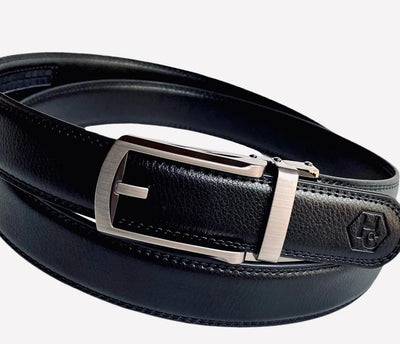

Leave a comment