



When Were Leather Belts Invented? A Short History
Quick answer: The oldest known leather belt belonged to Otzi the Iceman, a calf-hide utility strap dated to around 3300 BC and now held in an Italian museum. But the leather belt as we wear it today, threaded through loops on trousers, is a 20th-century standard. It didn't become the default way to hold up pants until belt loops appeared on Levi's 501 jeans in 1922, and belts overtook suspenders in general popularity by the late 1930s.
A timeline of the belt
| Period | Development |
|---|---|
| ~3300 BC | Otzi the Iceman's calf-hide utility strap, the oldest leather belt known to archaeologists |
| Bronze Age through antiquity | Belts used to hold tools and weapons; Roman military belts signaled rank, with more elaborate designs worn by higher-ranking soldiers |
| European Middle Ages | Belts and girdles become common accessories worn with tunics, robes, and early trousers |
| 1922 | Levi's adds belt loops to its 501 jeans |
| By 1938 | Roughly 60% of American men report preferring belts over suspenders, according to contemporary reporting |
Picks to go with this guide
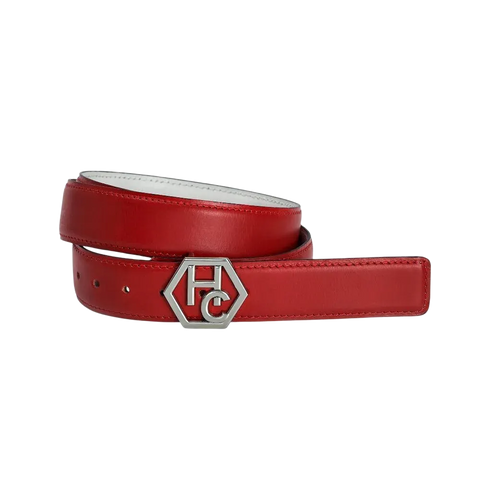

Black Leather Dress Ratchet Belt with Silver Frame Buckle - 1.15"
Slim dress trouser fit, micro-adjustable, interchangeable buckle
View product →
Black Leather Casual Ratchet Belt with Gunmetal Hollow Rectangle Buckle - 1.38"
Micro-adjustable fit, interchangeable buckle
View product →Why belts took so long to become standard trouser wear
For most of history, clothing was held up with cords, drawstrings, or suspenders rather than a belt threaded through fitted loops, since trousers themselves weren't commonly cut with belt loops until well into the 20th century. Once loops became a standard feature on work and casual pants, the belt's practical advantages, a single adjustable point of tension rather than two shoulder straps, made it the more convenient default fairly quickly.
What Otzi's belt tells us about early leather use
Otzi's belt was a functional strap rather than a decorative accessory: found alongside other calf-hide and hide-based gear from around 3300 BC, it was used to hold a pouch and secure clothing rather than to complete an outfit. That utilitarian purpose (holding tools, pouches, and weapons close at hand) was the primary reason people wore belts for most of human history, well before the belt took on the mixed functional-and-fashion role it holds today.
Roman military belts and status signaling
In the Roman army, the cingulum militare, a belt worn by soldiers, functioned as more than a practical accessory: its level of decoration and the metal fittings attached to it reflected the wearer's rank and length of service. Losing one's belt was itself a recorded form of military punishment, which underscores how tightly the object was bound up with a soldier's identity and standing, not simply a way to keep a tunic in place. That link between belts and identity echoes even in today's tactical gear, where the belt worn by Navy SEALs still communicates function and readiness rather than fashion.
What's changed since, and what hasn't
The materials and construction methods have advanced considerably: modern full-grain vegetable-tanned leather, reinforced stitching at the buckle, and mechanisms like the ratchet track-and-pawl buckle didn't exist in their current forms even a century ago. What hasn't changed is the basic function a belt serves: a single strip of durable material, closed with a buckle, holding clothing in place at the waist. Our guide to how much a good leather belt should cost covers how those modern construction improvements translate into what you actually pay today.
How the belt's role has shifted from tool-carrier to style statement
For most of the belt's history, its primary job was practical: holding tools, weapons, or pouches within reach. Only in the last century or so, as trousers with belt loops became standard and the need to carry gear on the body diminished for most people, did the belt shift toward being primarily a style element, something chosen to match shoes, coordinate with an outfit, or signal a particular aesthetic rather than to hold a weapon or a pouch of coins.
Belts in different world regions and cultures
The belt's evolution wasn't a single, linear Western story. Woven and beaded belts held ceremonial and symbolic significance in numerous Indigenous and African textile traditions long before European trouser-loop conventions existed. In parts of Asia, sashes and cloth obi-style belts served the same waist-securing function, with some of these traditions still worn today in formal and ceremonial settings alongside the now-globalized Western leather belt.
The industrial shift that made mass-produced belts possible
Before industrialized tanning and stitching, a leather belt was a hand-crafted item, relatively expensive and often made to order. Mechanized tanning and reliable machine stitching in the late 19th and early 20th centuries brought belt production to a scale that made owning several belts, rather than one lifetime piece, realistic for an average consumer, roughly alongside the belt loop's rise on mass-produced trousers.
Even with mass production now the norm, small workshops still make belts by hand rather than on an assembly line.
Frequently asked questions
Were belts always made of leather?
No. Early waist wraps and cordage used cords, fabric, and other plant or animal fiber before leather became the more common material. Leather won out because it could be shaped, reinforced with stitching, and trusted to carry the weight of tools, pouches, and weapons without stretching or fraying the way cloth cordage eventually would.
When did the modern buckle-and-loop belt design appear?
The buckle-and-loop design existed in various forms for centuries before it became the standard way to wear trousers. That only happened once belt loops turned into a common feature on pants in the early 20th century, starting with Levi's adding them to its 501 jeans in 1922, which set the pattern most trousers still follow today.
Did belts always signal social status?
In some periods, yes. Roman military belts, the cingulum militare, indicated rank and length of service through their level of decoration and metal fittings, and losing one's belt was itself a recorded form of military punishment. That symbolic weight has mostly faded from everyday wear, though belt style and quality still say something about how someone presents themselves.
Is the leather belt still evolving?
Yes. Mechanism innovations like the ratchet track-and-pawl buckle, which allows quarter-inch adjustment instead of relying on fixed holes, are a relatively recent development, refined mainly through patents filed in the 1980s and 1990s. Materials have shifted too, with vegetable-tanned full-grain leather and reinforced stitching now standard on well-made belts in a way they weren't a century ago.
What is the oldest surviving leather belt?
Otzi the Iceman's calf-hide utility strap, dated to roughly 3300 BC and discovered with his preserved remains in the Alps, is the oldest known leather belt and is held today in an Italian museum. It was a functional piece, used to hold a pouch and secure clothing, not a decorative accessory, which was typical of belts for most of early history.
Why did suspenders lose popularity to belts?
As belt loops became a standard feature on trousers through the early 20th century, a belt's single point of adjustment at the waist proved more convenient than suspenders' two shoulder straps. By the late 1930s, roughly 60% of American men reported preferring belts over suspenders, and that preference has held ever since.
When were leather belts invented?
The oldest known leather belt belonged to Otzi the Iceman, a calf-hide utility strap dated to around 3300 BC. The belt as a standard way to hold up trousers is far more recent, though; it didn't become the default until belt loops appeared on Levi's 501 jeans in 1922, and belts overtook suspenders in general popularity by the late 1930s.
How thick should leather be for a belt?
Most full-grain dress and casual belts run 3.5 to 4.5mm thick. That range holds its shape at the buckle fold and around the holes under daily tension without becoming too stiff to wear comfortably. Thinner leather is more prone to stretching and tearing at the holes over time.
What is the best leather for a belt?
Full-grain leather, ideally vegetable-tanned, is the best choice for a belt because it keeps the hide's densest outer fiber layer intact and holds up under the constant tension a belt carries all day. Corrected-grain and bonded leather have had that dense layer removed or compromised, so they stretch and wear faster.
How are leather belts made?
A belt starts as a hide that's tanned, commonly vegetable tanning for durability, then cut into straps at the right width and thickness. The strap is stitched at the buckle attachment, usually with multiple rows for strength, holes are punched and often reinforced with grommets, and edges are burnished or finished before the buckle is attached.
Who makes leather belts?
Belts are produced at every scale, from large factories mass-manufacturing bonded and corrected-grain belts to small workshops and independent leatherworkers hand-cutting and stitching full-grain belts one at a time.
How should leather belts be stored?
Hang a belt on a hook or coil it loosely rather than folding it sharply, since a sharp fold held under weight or over time can create a permanent crease. Keep it away from direct heat and prolonged sun exposure, which dry out and stiffen the leather faster than normal wear does.
Updated: October 8, 2026
More picks from the same range

Black Leather Ratchet Belt with Open Frame Buckle - 1.38"
Micro-adjustable fit, interchangeable automatic buckle
View product →
Black Leather Ratchet Belt with Silver Buckle - 1.38"
Micro-adjustable fit, interchangeable automatic buckle
View product →
Black Leather Ratchet Belt with Black Plate Buckle - 1.38"
Micro-adjustable, interchangeable buckle
View product →

Leave a comment