



How to Adjust or Disassemble a Ratchet Belt
Quick answer: Everyday adjustment on a ratchet belt needs no tools: feed the strap through the buckle to tighten, and hold the release lever on the buckle's underside to loosen it. Trimming the strap to a shorter length, or removing the buckle entirely, is a different, occasional task. On our belts, the buckle attaches with a toothed retaining pin, and the strap itself can be trimmed with an ordinary pair of scissors.
Daily adjustment (no tools needed)
- Tighten: pull the strap through the buckle; the spring-loaded pawl clicks forward on its own
- Loosen: press or hold the release lever on the underside of the buckle, then pull the strap back to the looser position
- The track adjusts in quarter-inch steps, so small day-to-day changes in fit don't require removing anything
Picks to go with this guide

Black Leather Dress Ratchet Belt with Silver Frame Buckle - 1.15"
Slim dress trouser fit, micro-adjustable, interchangeable buckle
View product →
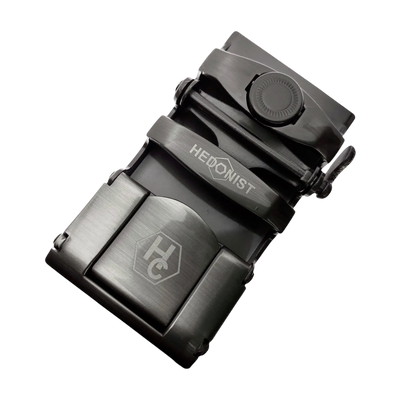
Black Leather Casual Ratchet Belt with Gunmetal Hollow Rectangle Buckle - 1.38"
Micro-adjustable fit, interchangeable buckle
View product →
Black Leather Ratchet Belt with Open Frame Buckle - 1.38"
Micro-adjustable fit, interchangeable automatic buckle
View product →Trimming the strap to length (one-time)
If a belt runs longer than you need past the last usable track position, the excess strap can be trimmed with an ordinary pair of scissors, no special leather tools required. Mark the length you need with the belt buckled at a comfortable fit, then cut past the last track tooth you want to keep. This is a one-way step, so it's worth marking carefully and cutting a little conservatively rather than trimming too much at once. If you haven't confirmed your correct size yet, how to measure your size for a ratchet belt walks through that first.
Removing the buckle
| Step | What to do |
|---|---|
| 1 | Locate the toothed retaining pin on the underside of the buckle, where the strap enters the housing |
| 2 | Release the pin to free the strap from the buckle housing |
| 3 | Slide the strap free once the pin is released |
| 4 | Reverse the steps to attach a new strap, or reattach the same one after trimming it to length |
Why belts are built this way
A toothed retaining pin, rather than a permanently riveted or glued connection, exists specifically so the buckle and strap are two independent, serviceable parts. That matters for two practical reasons: a strap that's slightly too long for your track range can be trimmed rather than the whole belt replaced, and a buckle that wears out or that you simply want to swap for a different finish can be changed without discarding a strap that's otherwise in good shape. If your existing buckle has stopped holding tension reliably, that's usually a mechanism problem rather than a reason to replace the whole belt; see how to fix a ratchet belt buckle that won't hold for how to diagnose it.
Adjusting different leather types the same way
The trimming and buckle-release steps above work the same regardless of leather type or color. A genuine leather ratchet belt and a real leather ratchet belt trim and reattach identically, since the difference between them comes down to tanning and finishing, not how the strap connects to the buckle. The same goes for color: a black leather ratchet belt and a brown ratchet belt use the same toothed retaining pin and the same scissors-and-mark approach to trimming. This applies across mens ratchet belt leather styles built for business wear and casual ratchet belt straps meant for jeans, and it holds for any automatic ratchet belt regardless of price point, since the buckle-and-track format is largely standardized across the category. Whether you call it a belt and ratchet setup or a belt with ratchet hardware, the mens belt ratchet mechanism inside is doing the same job.
Step-by-step: preparing the strap before trimming
- Put the belt on at your normal fit and note exactly where the strap sits comfortably through the buckle
- Mark that point clearly on the underside of the strap with a pencil or piece of tape before removing the belt
- Leave a small margin, roughly a quarter-inch past your mark, rather than cutting exactly at it, since it's easier to trim a bit more later than to add length back
- Cut cleanly with sharp scissors in one motion rather than several small cuts, which can leave a ragged edge
What to do if you trim too much
Trimming is a one-way operation, so cutting past the point where the track still has usable teeth means the belt can no longer reach its tightest comfortable setting. If that happens, the belt is not necessarily ruined: a buckle can often be reattached farther up the remaining track and simply used at a looser range than originally intended, but the cleanest fix is ordering a replacement strap sized correctly the first time around, since strap and buckle are sold as separable parts specifically for this reason.
How this compares to swapping parts on a traditional belt
A pin-and-hole belt typically has its buckle riveted permanently to the strap, so there's no equivalent of removing and reattaching it, and a strap that's too long simply gets tucked through a keeper loop rather than trimmed. The ratchet belt's removable buckle design is one of the more practical advantages of the format over a traditional belt, since it means a single strap can be reused with a different buckle finish, or a worn buckle can be replaced without buying an entirely new belt.
Tools worth keeping on hand for adjustments
Beyond a plain pair of scissors for trimming, a small flathead screwdriver or a flat plastic pry tool can help gently release a retaining pin that feels stiff on a newer belt, since the pin can fit snugly right out of the factory. Avoid using excessive force or metal tools that could scratch the buckle's finish; if the pin genuinely won't budge with light, steady pressure, it's worth checking the belt's included instructions for any brand-specific release mechanism before assuming something is stuck or defective.
Frequently asked questions
Do I need tools for normal daily adjustment?
No. Day-to-day tightening and loosening uses only the buckle's built-in release lever, no screwdriver or other tool required. Tools only come into play for the occasional one-time jobs of trimming the strap to length or swapping the buckle for a different style.
Can I swap the buckle on my ratchet belt for a different style?
Yes. Our ratchet belts use a toothed retaining pin to attach the buckle, specifically so the buckle can be swapped or the strap replaced without special tools, letting one strap work with several buckle finishes over time as your style changes.
What tool do I need to trim the strap?
An ordinary pair of scissors is enough. No leather punch, knife, or specialty tool is needed to cut the strap to length, since the leather is thin enough to cut cleanly in a single motion with a sharp blade.
What if the release lever feels stuck?
A lever that resists more than usual is often a sign of dirt or lint built up around the pawl. Try wiping the track and the lever area with a slightly damp cloth before assuming the mechanism itself is damaged or defective.
Is it safe to trim the strap myself?
Yes, our belts are built for it. It's still a one-way step, so mark the length carefully with the belt buckled at a comfortable fit before cutting, since removing too much leather can leave too little track for the buckle to engage properly.
Can I reattach the same buckle after trimming the strap?
Yes. Trimming the strap and detaching the buckle are independent steps; once the strap is cut to length, the same buckle reattaches through the toothed retaining pin exactly as it did before, with no change to how it engages the track.
What happens if I trim the strap too short?
Unlike ordering the wrong size, this mistake can't be undone by reattaching the buckle differently in most cases, since the removed leather can't be added back. Measure twice and cut conservatively, leaving a small margin, rather than trimming to the exact mark on the first pass.
Is it normal for a brand-new retaining pin to feel stiff the first time I try to release it?
Yes, this is common on a belt straight out of the box, since the pin hasn't been worked yet. Gentle, steady pressure with a small flathead tool usually frees it; it should move more easily each time after that first release.
How do I adjust the length of a leather belt?
For day-to-day fit, feed the strap through the buckle to tighten or hold the release lever to loosen, no tools involved. For a permanent change to the belt's overall length, mark your comfortable fit with the belt buckled, then trim the excess strap with scissors past the last track tooth you want to keep, following the same process outlined above.
Updated: October 8, 2026
If the buckle feels loose after cleaning and reassembly, see how to fix a ratchet belt buckle that won't hold. For sizing before you trim, check how to measure your size for a ratchet belt, and for how the mechanism works, see how does a ratchet belt buckle work. Browse our ratchet belts for replacement straps and buckles.
More picks from the same range

Black Leather Ratchet Belt with Silver Buckle - 1.38"
Micro-adjustable fit, interchangeable automatic buckle
View product →
Black Leather Ratchet Belt with Black Plate Buckle - 1.38"
Micro-adjustable, interchangeable buckle
View product →
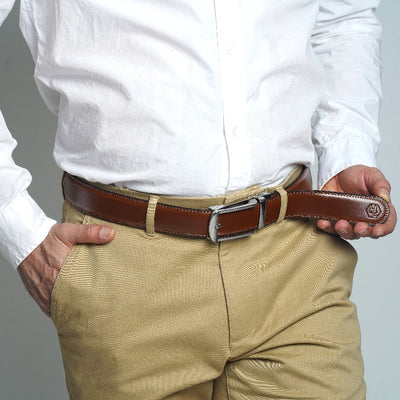
Dark Brown Leather Ratchet Belt with Polished Silver Buckle - 1.38"
Micro-adjustable, interchangeable buckle system
View product →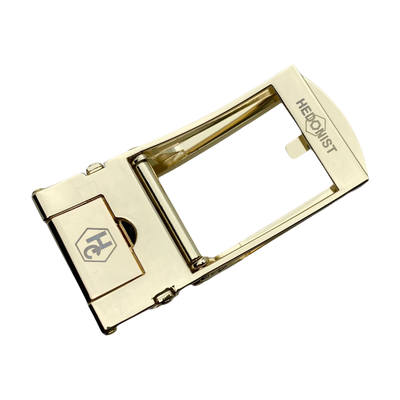

Leave a comment