



How to Fix a Ratchet Belt Buckle That Won't Hold
Quick answer: A ratchet belt that slips, won't hold tension, or feels loose by the end of the day usually has one of three problems: dirt or lint built up on the track, a worn pawl that no longer catches the teeth cleanly, or a spring that has lost tension. The first is fixable at home; the other two usually mean the buckle mechanism needs replacing.
Diagnose the problem first
| Symptom | Likely cause | Fixable at home? |
|---|---|---|
| Belt slips loose gradually through the day | Worn pawl or weakened spring | No - mechanism needs replacing |
| Buckle feels gritty or catches unevenly | Dirt or lint on the track or pawl | Yes - cleaning usually resolves it |
| Release lever is stiff or won't move | Debris around the lever or pawl | Yes - cleaning usually resolves it |
| Buckle won't engage the track at all | Bent pawl, broken spring, or damaged track teeth | No - mechanism or strap needs replacing |
Picks to go with this guide

Black Leather Dress Ratchet Belt with Silver Frame Buckle - 1.15"
Slim dress trouser fit, micro-adjustable, interchangeable buckle
View product →
Black Leather Casual Ratchet Belt with Gunmetal Hollow Rectangle Buckle - 1.38"
Micro-adjustable fit, interchangeable buckle
View product →
Black Leather Ratchet Belt with Open Frame Buckle - 1.38"
Micro-adjustable fit, interchangeable automatic buckle
View product →Cleaning fix for a gritty or slipping buckle
- Wipe the interior track surface with a slightly damp cloth to remove dirt, lint, and pocket debris
- Use a dry cotton swab or compressed air to clear buildup around the pawl and spring inside the buckle housing
- Avoid getting leather conditioner on the track itself; conditioner residue there can make the surface slippery and interfere with pawl engagement rather than help it
- Let everything dry fully before wearing the belt again
When the mechanism itself has failed
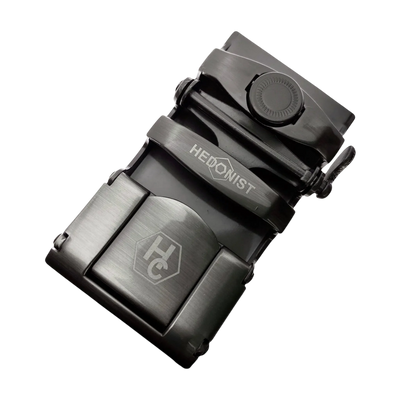
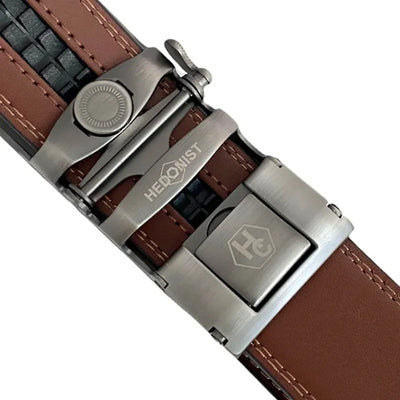
If cleaning doesn't restore reliable engagement, the pawl or spring has likely worn out or lost its temper, which is a manufacturing quality issue rather than something a cloth and some patience can fix. Our ratchet belts use a toothed retaining pin to attach the buckle specifically so it can be replaced on its own, without buying a whole new belt. Release the retaining pin, remove the worn buckle, and attach a replacement to the same strap; see how to adjust or disassemble a ratchet belt for that process step by step.
A closer look at why pawls and springs wear out
The pawl absorbs a small mechanical shock every time it catches a tooth on the track, thousands of times over the life of a belt worn daily. A pawl machined from properly hardened steel resists that repeated impact for years without deforming. A softer or poorly heat-treated pawl gradually rounds off at the contact edge, so it starts sliding past teeth instead of catching cleanly, which shows up as gradual slipping rather than a sudden failure. The spring behaves similarly: a well-tempered spring keeps pushing the pawl against the track at consistent force indefinitely, while a lower-grade spring gradually relaxes, weakening that pressure until the pawl no longer seats firmly enough to hold under normal tension. Our guide to how a ratchet belt buckle works covers what these parts look like and how they interact when everything is functioning correctly.
Preventing buckle failure going forward
- Wipe the track clean monthly if you wear the belt daily, since dirt buildup is the most common cause of gradual slipping
- Keep conditioner off the interior track surface when treating the leather
- Avoid forcing the release lever past its normal range of motion, which can bend the pawl or damage the spring over time
When it's worth replacing the whole belt instead of just the buckle
A replacement buckle makes sense when the strap itself is still in good condition: no cracking, no significant fading, stitching intact. If the strap has also reached the end of its useful life at the same time the buckle fails, replacing the whole belt is often the more practical choice, since a worn strap paired with a new buckle will still show its age even with a fully functional mechanism. Our guide to what to look for in a ratchet belt brand covers the specific pawl and spring quality markers worth checking before buying a replacement, whether that's a new buckle alone or a full belt.
Choosing a replacement automatic buckle
When it's time to replace rather than clean, look for a belt automatic buckle built with a hardened steel pawl and spring rather than the cheapest automatic belt buckle you can find, since the mechanism quality is exactly what failed the first time. This applies whether you're working with ratchet belt straps on a brown ratchet belt worn casually or a black one for the office; the internals matter more than the finish. A well-built automatic ratchet belt should outperform a basic pin buckle belt precisely because a properly made track-and-pawl system holds tension more consistently over years of daily wear. If you are replacing a belt, our ratchet buckles ($23) detach and fit straps of the same width.
How to test if your fix actually worked
After cleaning or replacing the mechanism, test it before wearing the belt through a full day. Buckle it at your normal fit, then gently tug the loose end of the strap; a properly working pawl should hold firm without any perceptible slip. Repeat this a few times at different tightness settings across the track, since a mechanism can sometimes catch reliably at one position while slipping at another if a specific tooth or a localized section of the pawl is affected. If the belt holds firm across the full range you'd normally use, the fix has worked; if it slips at any point, the mechanism likely needs replacement rather than further cleaning.
Frequently asked questions
Why does my ratchet belt only slip after a few months?
This pattern usually points to a lower-quality pawl or spring that wears down faster than it should under normal use, rather than anything you did wrong. It's a manufacturing issue, not a maintenance one.
Can I lubricate the buckle to fix slipping?
No. Lubricant on the track surface reduces the friction the pawl needs to grip the teeth, which can make slipping worse rather than better. Cleaning with a dry or slightly damp cloth is the right approach, not oil or grease.
Is a slipping ratchet belt a safety issue?
It's mainly a functional annoyance rather than a hazard, but a belt that won't hold reliably has effectively stopped doing its job and is worth cleaning or replacing rather than living with the constant readjustment.
How long should a good ratchet mechanism last before any of this happens?
A well-made mechanism with a hardened steel pawl and a properly tempered spring should maintain consistent engagement through years of daily use with nothing more than occasional cleaning. Slipping within the first several months typically points to a quality problem with that specific mechanism.
Can a bent pawl be straightened instead of replaced?
Not reliably. Hardened steel that has bent under stress has usually also lost some of its temper at that point, so straightening it rarely restores full holding strength. Replacing the buckle assembly is the more dependable fix in nearly every case.
Does trimming the strap ever affect the buckle's ability to hold?
Not if the trim is done correctly, past the last track tooth you want to keep. A trim that cuts too close to the final tooth, or through a tooth itself, can leave too little intact track for the pawl to catch reliably at that end of the range.
Should I try to fix the mechanism myself if I'm not sure what's wrong?
Start with cleaning, since it resolves the majority of slipping and sticking complaints and carries no risk of damaging anything. If cleaning doesn't help after a day or two of normal wear, the mechanism itself is the likely cause and replacement is the more reliable path forward.
How soon after cleaning should I know if the fix worked?
You can test it immediately by tugging the strap at several tightness settings before wearing the belt for the day. A mechanism that holds firm under a firm manual tug across the range you use will almost always hold up through normal daily wear too.
How do I fix a leather belt buckle that won't stay tight?
Start by cleaning the track and the area around the pawl with a dry or slightly damp cloth, since built-up dirt is the most common cause. If the buckle still slips after cleaning, the pawl or spring has likely worn out, and replacing the buckle assembly (rather than the whole belt) is the fix, since the strap itself is usually still fine.
How do I fix a leather belt in general when something feels off?
First figure out whether the problem is the buckle or the strap. A buckle issue shows up as slipping, sticking, or a stiff release lever, and cleaning solves most of those. A strap issue like stretching, cracking, or peeling is a separate leather care problem and isn't fixed by cleaning the buckle mechanism.
How do I change the buckle on a leather belt to fix a slipping problem?
Release the toothed retaining pin on the underside of the old buckle to free the strap, then slide the strap into a replacement buckle of the same width and close the pin. Test the new buckle by tugging the strap at a few tightness settings before wearing it for a full day.
Updated: September 27, 2026
More picks from the same range

Black Leather Ratchet Belt with Silver Buckle - 1.38"
Micro-adjustable fit, interchangeable automatic buckle
View product →
Black Leather Ratchet Belt with Black Plate Buckle - 1.38"
Micro-adjustable, interchangeable buckle
View product →
Dark Brown Leather Ratchet Belt with Polished Silver Buckle - 1.38"
Micro-adjustable, interchangeable buckle system
View product →
Leave a comment